Maybe you just left your ultrasound appointment with a heavy heart - told there were two babies, then only one. Or, your doctor told you about vanishing twin syndrome, and you looked for more information when you got home. No matter what brought you here, know that you are not alone and that this guide was made just for you.
Vanishing twin syndrome occurs when one embryo in a multiple pregnancy stops developing and is naturally absorbed by the mother's body, most often in the first trimester, and most commonly discovered through a follow-up twin pregnancy early ultrasound. It is more common than most people realise, and understanding it fully is the first step toward feeling less afraid.
In this guide, we cover exactly what vanishing twin syndrome is, what your week-by-week ultrasound scans mean, how it affects you and your surviving baby, and where to find the right support. But first - the question every parent in your position is really asking:
"If vanishing twin syndrome happened to me, will my surviving baby be okay?" Let's answer that together, from the very beginning.
What Is Vanishing Twin Syndrome?
It's totally normal to feel confused when your doctor talks about vanishing twin syndrome. When you hear it for the first time, it sounds almost impossible. After seeing what it goes with, it's not as scary and is better to carry.
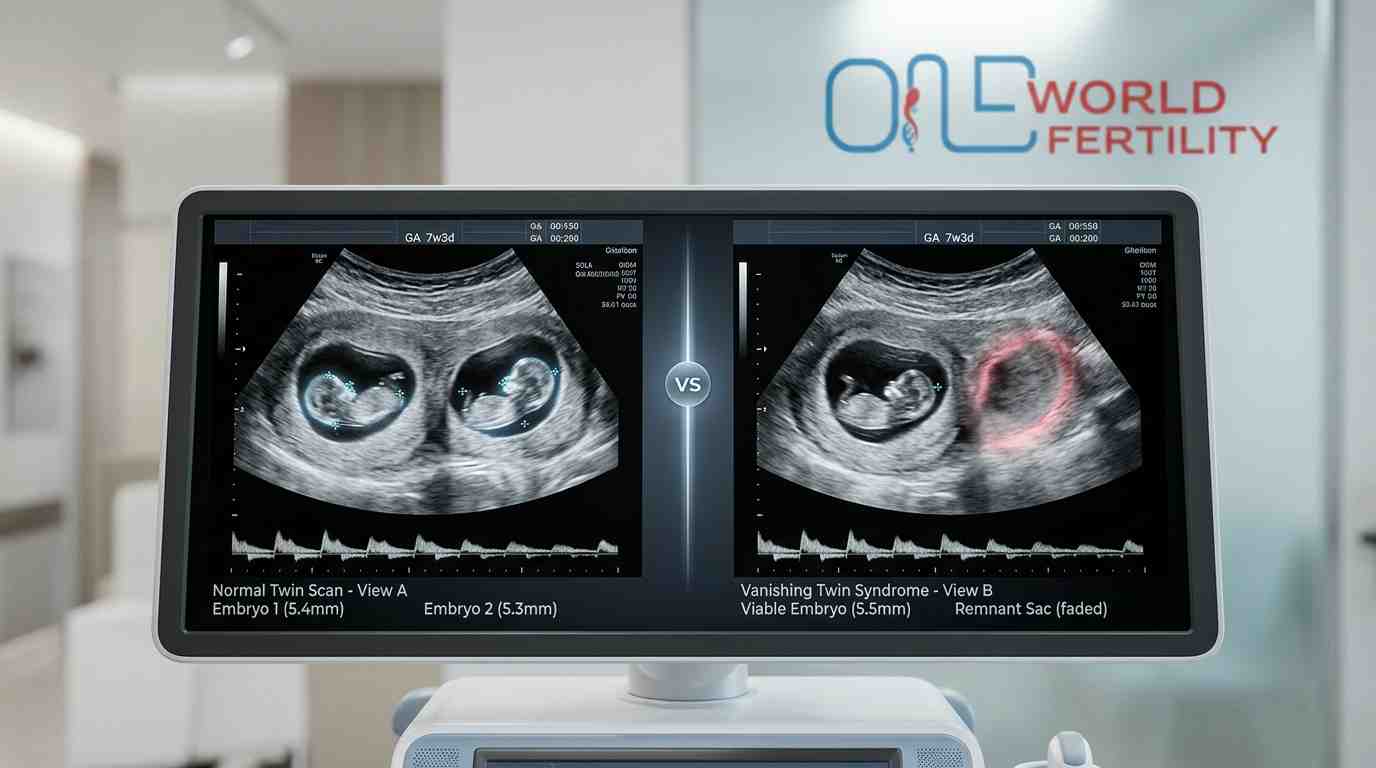
"Vanishing twin syndrome is when one embryo in a multiple pregnancy quietly stops developing and is gently absorbed back into the mother's body, the placenta, or the surviving twin. When a twin absorbs the other, sometimes informally described as one twin "eating" the other, it's actually a natural biological process. How do twins absorb each other?
The body simply reabsorbs the tissue cells of the lost embryo, which is gentle and harmless to the surviving baby."It usually occurs in the first three months of pregnancy and is detected when a second ultrasound confirms that there is one fewer baby than the first scan showed.
Your body makes β-hCG (Beta-human chorionic gonadotropin) to support and promote early pregnancy. In vanishing twin syndrome hcg levels often plateau or drop unexpectedly when one twin stops growing, this is sometimes the first quiet signal before an ultrasound confirms what's happening..
Is Vanishing Twin Syndrome the Same as Disappearing Twin Syndrome?
If you're searching online for what vanishing twin syndrome is? And keep coming across different names like disappearing twin syndrome, twin vanishing syndrome, and vanishing syndrome, know that they all mean the same thing. You're not reading about different things. In the early days of medicine, the term "vanishing twin" was used to describe a situation in which one baby would disappear between scans.
Along with it, "disappearing twin syndrome" grew as an alternative name that was used in many clinics and study groups. Same thing, same meaning- just different words for a broken heart that needs a single, clear reason.
When Was Vanishing Twin Syndrome First Recognized?
Since 1945, doctors have known about Vanishing twin syndrome, but back then, there was no way to find it during pregnancy with an ultrasound. Doctors could only be sure that a twin had been lost by looking at the placenta after the baby that was still alive had been born. There, small bits of fetal tissue were sometimes the only quiet proof that there had been a second life for a short time. Early ultrasounds were the only way to finally see and understand disappearing twins, where the mother was still pregnant.
We're here to give you the answers you need, even if they are hard, because tests are happening earlier today.
Vanishing Twin Syndrome - Quick Facts at a Glance
Fact
|
Detail
|
First recognized
|
1945
|
How common
|
21%–36% of multifetal pregnancies
|
Primary cause
|
Chromosomal abnormalities at conception
|
When it usually happens
|
First trimester - before week 12
|
How it is diagnosed
|
Early ultrasound + follow-up scan
|
β-hCG role
|
Plateauing levels may signal one embryo is lost
|
1st trimester loss -mother
|
Usually no complications
|
1st trimester loss -surviving twin
|
Excellent prognosis
|
2nd or 3rd trimester loss
|
High-risk -closer monitoring needed
|
In IVF pregnancies
|
7%–36% of multiple pregnancies
|
How Common Is Vanishing Twin Syndrome?
People who have been through this should know that they are not alone. A lot more people have Vanishing twin syndrome than most people think. The number of cases studied ranges from 21% to 36% of all multifetal pregnancies. That's about one in three births with twins. Many families have gone through the same thing in silence.
More people know about it now, but not because it's happening more often. It's because early ultrasounds let us see twins in the womb months before they were seen before. What couldn't be seen before can now be seen. That means more people are getting the truth, even if it hurts.
Age also has an effect. Vanishing twin syndrome is more common in women over 30. This is because babies naturally have different chromosomes as the mother gets older. You did not make this happen. It's just something your body was carrying in silence.
What Makes IVF Pregnancies More Vulnerable to Vanishing Twin Syndrome?
Since we already talked about it, vanishing twin syndrome is found in 7%–36% of IVF multiple-baby pregnancies. This happens because IVF pregnancies are scanned earlier and more often than natural pregnancies. This means that anything that might not have been seen during a natural conception is now very plain. Your care team will be able to see, understand, and help you more if you have your first scan early.
What Causes Vanishing Twin Syndrome?
When parents find out their child has vanishing twin syndrome, one of the first things they usually ask is, "Did I do something wrong?" We want to say no in a kind but firm way. Most of the time, vanishing twin syndrome is caused by things that happen very early in pregnancy, before the woman even knows she is pregnant. Your body did not fail. Nature had just run into something it couldn't handle.
Now that you understand, let us go over the exact reasons why this happens, starting with the most common one.
Chromosomal Abnormalities - The Most Common Cause
The most common reason a vanishing twin stops developing is a chromosomal abnormality present right from the moment of conception. That baby can't grow the way it needs to because of something in its genetic code that has been there since the first time its cells split.
This is not because of what you ate, how you felt, what you did, or what you didn't do. It doesn't say anything about your health or your body's strength. Nature was sending a quiet message that this embryo wasn't going to make it, and your body, being smart, responded appropriately.
But this doesn't just happen because of genetic problems. There are times when the cause is more physical, like how the pregnancy was supported from the very beginning.
Improper Cord Implantation
There are times when the cause is more structural. The umbilical cord of one twin cannot settle in the placenta in the right place, so that twin cannot receive the steady flow of blood and nutrients it needs to develop.
One twin stops growing slowly in the womb if that lifeline isn't properly in place. This isn't because something went wrong with the pregnancy, but because the physical relationship was never strong enough to support two.
Now let's talk about another important thing, especially if your twins share a womb.
Placental Abnormalities - Monochorionic Risk and the Link to TTTS
It's important to fully understand this, especially if you are having twins or have carried twins who shared a placenta.
Twins are either monochorionic, which means they share a placenta, or dichorionic, which means each has their own. If twins share a placenta, nutrients and blood must be sent between them through the same channels. One twin can be greatly harmed if that ratio changes, and this can sometimes lead to vanishing twin syndrome.
It's also important to know about Twin-to-Twin Transfusion Syndrome (TTTS), which is closely linked to vanishing twin syndrome and something that many parents who look into the risks of monochorionic twins come across. The small difference between the two is this:
- Vanishing twin syndrome: One twin stops growing and is taken back up by the mother's body.
- TTTS: At first, both twins are alive, but the shared placenta causes dangerously uneven blood flow, cutting off one baby from getting enough oxygen.
They are not the same, but they both have the same risk: a shared placenta. A related condition called stuck twin syndrome can also occur in monochorionic pregnancies, where one twin becomes immobilised due to severely reduced amniotic fluid, often as a complication of TTTS. Your fertility doctor will keep an eye on both of your kids to see if they are or were monochorionic. Besides the placenta, there are a few other things you should know about that can affect this, and some of them you can actually change
Genetic, Autoimmune, and Environmental Factors
Besides genes and where the cord is placed, there are a few other things that may also play a part. Infections like rubella in the mother, autoimmune diseases like lupus, and lifestyle choices like smoking, drinking, and a bad diet can all make it more likely for a fragile embryo to not survive. The good news is that these are the things you can do the most to help.
Finally, we know what causes disappearing twin syndrome. The next question is, how do doctors find it? Let's go through that week by week.
What Causes Vanishing Twin Syndrome - A Simple Breakdown
What May Cause It
|
What Happens
|
How Likely
|
Chromosomal abnormalities
|
Embryo cannot develop due to genetic errors at conception
|
Most common - not your fault
|
Improper cord implantation
|
One twin doesn’t receive enough blood or nutrients
|
Moderately common
|
Shared placenta (monochorionic)
|
Unequal nutrition between twins — also linked to Twin-to-twin transfusion syndrome (TTTS)
|
Significant risk
|
Maternal age over 30
|
Higher chance of chromosomal variations in embryos
|
Increased risk
|
IVF pregnancies
|
Not all transferred embryos survive
|
7%–36% of IVF multiples
|
Maternal infections (rubella)
|
Can disrupt early fetal development
|
Less common
|
Autoimmune conditions
|
Affects how well the placenta supports both embryos
|
Possible factor
|
Lifestyle factors
|
Smoking, alcohol, poor nutrition
|
Within your control to manage
|
Hidden Twin Pregnancy - Could You Be Carrying Two?
Before a twin pregnancy is ever confirmed on a scan, your body often already knows something is different. Some parents describe this as hidden twin syndrome, when the body shows clear signs of carrying twins, but only one baby is visible on the early scan. After being told their child has vanishing twin syndrome, many parents realise the signs were there the whole time; they didn't know what they were seeing. Let's talk about how those early signs feel and what they might be trying to tell you.
Early Signs That You Might Be Pregnant with Twins
If you are pregnant with twins, your body is working harder than in a singleton pregnancy from the very beginning - and it usually shows. These are the signs that often show up early and feel better than expected:
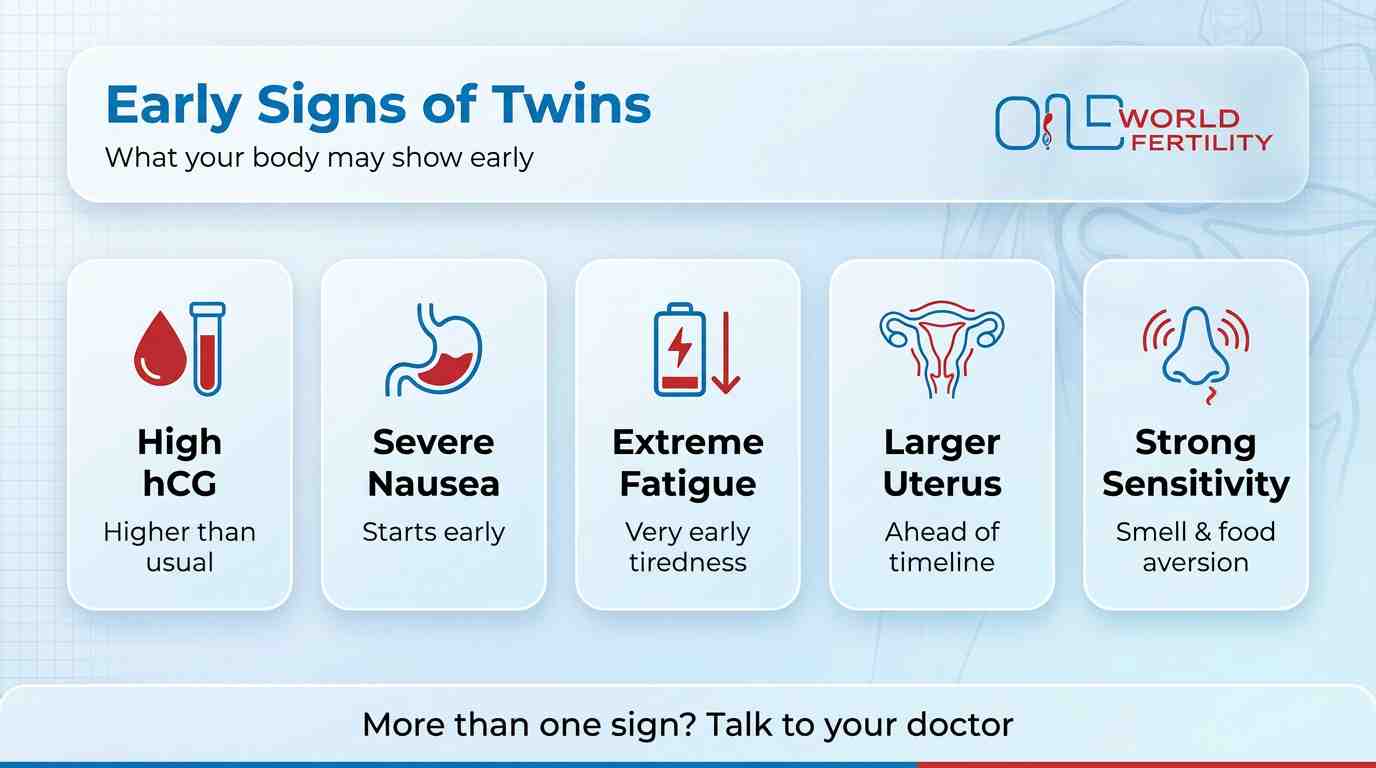
- Unusually elevated β-hCG levels - significantly higher than typical singleton readings at the same stage
- More severe sickness that starts earlier and is hard to control, even in the first few weeks
- Getting very tired very quickly, much faster and worse than most people expect
- A uterus that is bigger than it should be for your gestational age
- Stronger dislikes of certain foods and a stronger sense of smell that even surprises you
None of these signs alone proves you are having twins, but if you have more than one, you should talk to your doctor, especially if they feel very strong this early on.
Can a Twin Be Hidden Before Your First Ultrasound?
A single gestational sac seen on a 5-week ultrasound does not always mean that you are having a single baby. At 5 weeks, you might not yet be able to see a second embryo, or it might be quietly disappearing before your first visit.
Can you have hidden twin pregnancy symptoms before a missed period? Yes, some women feel very sick, very tired, and more sensitive to smells before they even miss their period. This is sometimes the body's quiet way of telling them it's carrying two.
A second baby that was there for a short time may be gone by the time your ultrasound scan test comes around. You would not have known about it. Someone lived, but no one ever saw them.
Vanishing Twin Syndrome and Early Ultrasound - Week by Week
The early ultrasound had to be there before vanishing twin syndrome could be known. Parents today can get the truth from those scans. Sometimes the truth is hard to hear, but you earn it. Let us walk through what each week shows you, starting from the very beginning.
Twin Ultrasound at 5 Weeks -What You Might See
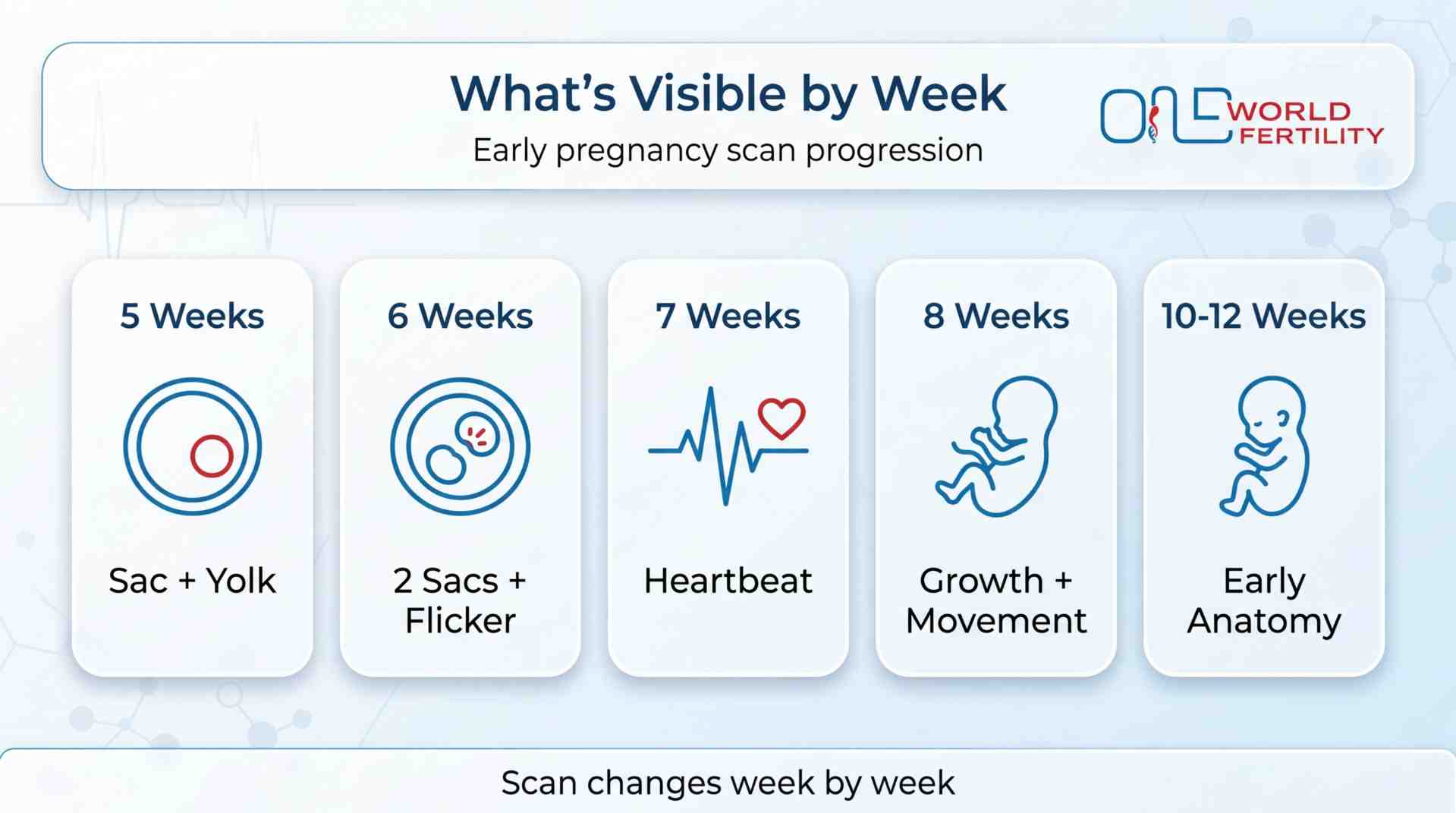
At a 5-week ultrasound for twin pregnancies, the sonographer will look for a gestational sac and a yolk sac, as these are the earliest signs of pregnancy. At this point, you might or might not be able to see a second sac.
A single intrauterine gestational sac at 5 weeks does not always indicate a single baby. This is something that many people do not know. When twins are 5 weeks along, sometimes only one sac is seen on ultrasound, even though there are two eggs. Vanishing twin syndrome can also start in the background before this check happens. The 5-week scan may feel tight, but it sets the stage for the visit that will likely change everything.
Twin Ultrasound at 6 Weeks - The Most Common Discovery Window
The 6-week ultrasound appointment for twins is where most vanishing twin syndrome stories begin. A sonogram of 6-week-old twins can now show two gestational sacs, early fetal poles, and the first faint flickers of heartbeat. It is often the moment parents first hear you are having twins.
That is what makes the follow-up scan so emotionally heavy. When parents return at 8 weeks, and only one baby remains, that gap between the twin pregnancy 6 weeks ultrasound and the next scan is incredibly painful. If that is your story, what you felt was real. The loss was real. But between that 6-week scan and the 8-week confirmation, there is one more important step - the 7-week heartbeat check.
Twin Ultrasound at 7 Weeks - Heartbeat Confirmation Stage
Your doctor can now hear two heartbeats by week seven, which is a big thing, but in the 7-week ultrasound scan for twins, two different heartbeats should be easy to see, so there may be a problem with the second baby if there is only one heartbeat.
No matter what, your doctor will not make any decisions based on just one scan. They will look at the early ultrasound of your twin pregnancy from week 6 and compare it to what they see now at week 7. Since a single picture only shows one part of the story. When you put two scans side by side, you can see the whole picture.
And that whole picture, no matter how hard it is to see, is clearest at the 8-week scan.
Twin Ultrasound at 8 Weeks - Confirming Vanishing Twin Syndrome
This is where vanishing twin syndrome is most often confirmed, which is an ultrasound at 8 weeks of pregnancy with twins. By the time of a vanishing twin ultrasound 9 weeks scan, the diagnosis is usually clear, the second sac may have collapsed completely, or only minimal tissue remains, while the surviving baby continues to grow normally. Your doctor can now see your baby's heartbeat, size, and movement. The ultrasound at 8 weeks will show if the second sac has disappeared. Your doctor will gently let you know what has happened.
These are the times that most parents will never forget. One baby is getting stronger, and the other, which was dead, is okay to be sad and thankful at the same time.
What Your Twin Ultrasound Shows Week by Week
Week
|
What’s Visible
|
VTS Detection
|
Key Warning Sign
|
5 weeks
|
Gestational sac, yolk sac
|
Possible
|
Single sac may not rule out twins
|
6 weeks
|
Two sacs, fetal poles, heartbeat flickers
|
Most common discovery point
|
One sac absent on follow-up
|
7 weeks
|
Heartbeats via Doppler
|
VTS suspected
|
Only one cardiac signal found
|
8 weeks
|
Fetal size, movement, cardiac activity
|
VTS formally confirmed
|
Collapsed or absent second sac
|
10–12 weeks
|
Early anatomy visible
|
Usually confirmed before this
|
Fetus papyraceous possible
|
Signs and Symptoms of Vanishing Twin Syndrome
Actually, not all the time. A lot of people feel great. No harm, no blood, and nothing strange. A new ultrasound will show which baby has moved into the other baby's place. For those who told that story, know this: you did nothing wrong. There were no secret signs of twin pregnancy that you missed. The only way to know for sure if someone has vanishing twin syndrome is to do a scan. Although the body does sometimes show a few small signs, here is what to look out for.
Common Symptoms in the First Trimester
Some women do notice small changes during vanishing twin syndrome; light bleeding with vanishing twin syndrome is one of the most commonly reported signs, though it's not always present. These are easy to confuse with normal early pregnancy feelings, but they are worth paying attention to:

- Light spotting or bleeding
- Mild cramping in the lower belly
- Dull pelvic or back pain
- Pregnancy symptoms, suddenly feeling lighter - like nausea fading too soon
- β-hCG levels in blood tests that stop rising the way they should
If you notice any of these vanishing twin symptoms in early pregnancy, just let your doctor know. Not to panic - simply so they can keep an eye on you. Most of the time, these signs are mild. But there are some signs that need attention right away - and those are important to know.
Symptoms That Need Immediate Medical Attention
These are not typical signs of disappearing twin syndrome. Feel any of these things right away? Call your doctor or go to the emergency room:
- A lot of blood
- Severe pain in the stomach or belly
- Suddenly, a very high fever
- Sharp pain in the pelvis and feeling dizzy
Do not wait and see. Get it checked out right away if something doesn't feel right. Always put your baby and your health first.
Effects on the Mother After Vanishing Twin Syndrome
The first thing most moms want to know after being told they have disappearing twin syndrome is "What is happening to my body right now?" Let us explain it to you in a clear and honest way.
What Happens to Your Body After a First Trimester Loss?
The tissue from the twin that is disappearing is quietly taken up by your body, the placenta, or the twin that is still alive. Many parents wonder how long vanishing twin DNA lasts. Traces of the lost twin's DNA can remain in the surviving twin or placenta for weeks to months, but cause no harm. There is no harm left behind.You are still pregnant, but you only have one baby. Usually, both you and your baby are fine.
But if the loss happens later in the pregnancy, you need to be a little more careful.
What If the Twin Is Lost After the First Trimester?
If you have disappearing twin syndrome after the first trimester, your doctor will keep a closer eye on you. This is what they will look out for:
- More likely to get gestational diabetes
- Chance of going into labour early or being forced
- Low amounts of amniotic fluid
- Ultrasound scans are more often
This doesn't always mean that something is wrong. It just means that you will get more help and care while you are pregnant. There is a very small chance that something else will happen later, and you should know about it.
What Are Fetus Papyraceous and Fetus Compressus?
Though it doesn't happen often, the tissue of a lost twin does not fully absorb after the baby is born. As the twins still alive grow in the womb, they push into that space, making the lost twin flatten over time. Doctors may find either of these at birth:
What It Means
|
How It Looks at Delivery
|
Fetus Compressus
|
Lost twin is compressed by the surviving twin - still recognizable but flattened
|
Fetus Papyraceous
|
Lost twin has lost all fluid and soft tissue - almost paper-thin in appearance
|
Both are very rare, and your medical team will be very careful with them. You are just better prepared if you know about them.
Effects on the Surviving Twin
When disappearing twin syndrome is diagnosed, the one thing that every parent really wants to know is, 'Is my baby who is still alive going to be okay?' This experience, sometimes informally called surviving twin syndrome, focuses on how the remaining baby develops after the loss of their sibling.
Does Vanishing Twin Syndrome Affect the Surviving Baby?
Most of the time, the baby that survives is fine, especially if the loss happens in the first trimester. In most cases, the expectation for twins who are still in the womb is very good. Whether the twins shared a placenta or not makes a big difference in how much the surviving twin is affected.
Does Sharing a Placenta Make It More Risky for the Surviving Twin?
Yes, it does make a difference. If your twins had separate placentas, the twin that is still alive probably won't be harmed. But if they shared one placenta, the risks are higher - because both babies were connected through the same blood supply.
Monochorionic twins also have an extra risk called Twin-to-Twin Transfusion Syndrome (TTTS), which makes the flow of blood between the twins uneven. Your doctor will also look for signs that your babies were monochorionic.
Can Vanishing Twin Syndrome Cause Cerebral Palsy in the Surviving Twin?
People often ask this question, so it needs an honest answer. A study from 1997 found a possible link between cerebral palsy and vanishing twin syndrome. But this was later questioned, and it was found that there was no major difference between this pregnancy and other twin pregnancies. The study we have now does not confirm a proven link. Some parents also ask about vanishing twin and autism, but current research does not establish any confirmed connection between vanishing twin syndrome and autism in the surviving baby. Talk to your doctor about these fears before you carry them around.
What About Birth Weight and Health at Birth?
If the loss happens in the second or third trimester, the twin that is still alive may:
- Not as heavy as expected at birth
- An Apgar score that is a little lower at birth
- A small but higher health risk in the first week, which could mean needing help in the NICU
Your care team will be watching and preparing for all of this - so your baby has every possible advantage from day one.
How Vanishing Twin Syndrome Affects the Surviving Twin
Risk Factor
|
1st Trimester Loss
|
2nd or 3rd Trimester Loss
|
Overall outlook
|
Excellent
|
Needs close monitoring
|
Growth in womb
|
Usually normal
|
May be smaller than expected
|
Birth weight
|
Normal
|
Risk of low birth weight
|
Apgar score
|
Normal
|
May be lower
|
Cerebral palsy risk
|
Not confirmed
|
Higher with shared placenta
|
First week health risk
|
Not elevated NICU
|
may be needed
|
Placenta impact
|
Minimal if separate
|
Significant if shared
|
TTTS risk
|
Not applicable
|
Monitor throughout
|
Monitoring needed
|
Standard schedule
|
Frequent ultrasounds
|
Vanishing Twin Syndrome and IVF - What Fertility Patients Need to Know
If you are going through IVF and have heard from a doctor about disappearing twin syndrome, there are a few things you should know. Let's keep things easy.
Why Is Vanishing Twin Syndrome More Common in IVF?
When IVF is used to transfer more than one egg, not all of them always make it. This is the reason why disappearing twin syndrome happens in 7% to 36% of IVF multiple pregnancies. It's not because of IVF; it's just because more eggs are put in at once. Also, people who get IVF are checked earlier, so vanishing twin syndrome is found earlier than in a natural pregnancy. But there is something many people going through IVF get wrong, and it's important to know the right answer.
What Is the Difference Between a Vanishing Embryo and Vanishing Twin Syndrome?
These are two very different things - and almost nobody explains this clearly:
Aspect
|
Vanishing Embryo
|
Vanishing Twin Syndrome
|
What it is
|
Embryo never implants
|
Implanted embryo stops developing
|
Detected by
|
β-hCG not rising
|
Follow-up ultrasound
|
Medical term
|
Failed implantation
|
Early pregnancy loss
|
Emotional impact
|
Failed cycle
|
Confirmed pregnancy loss
|
Both are painful. But they are not the same - and you deserve to know the difference.
When Should You Have Your First Scan After IVF?
Most fertility clinics schedule the first twin pregnancy's early ultrasound at 6 to 7 weeks after transfer. Because of this earlier time, vanishing twin syndrome is found more often in people who have IVF. If you don't know when your scan is, call the doctor. It's always better to be early.
Natural Twin Pregnancy vs IVF Pregnancy (VTS Comparison)
Factor
|
Natural Twin Pregnancy
|
IVF Pregnancy
|
VTS prevalence
|
21%–30%
|
7%–36%
|
First ultrasound
|
8–12 weeks
|
6–7 weeks post-transfer
|
VTS detection
|
Lower
|
Higher - due to earlier scanning
|
β-hCG monitoring
|
Less frequent
|
Closely tracked
|
Specialist
|
Obstetrics and Gynecology (OB-GYN)
|
Reproductive Endocrinology specialist
|
Emotional context
|
Often unexpected
|
Often discussed before transfer
|
You Do Not Have to Go Through This Alone
Finding out about vanishing twin syndrome is never easy. Whether you are still processing what happened, watching a multiple pregnancy closely after IVF, or simply looking for a team that truly understands - we are here for you. At One World Fertility, our specialists are ready to guide you with the right scans, the right answers, and the kind of care that actually feels human. Because you deserve nothing less.
[Book a Consultation Today at One World Fertility]
Frequently Asked Questions
A single intrauterine gestational sac means twins may still be possible - at 5 weeks a second embryo may simply not yet be visible. It does not automatically confirm a singleton pregnancy.
Vanishing twin syndrome is most commonly discovered between the twin ultrasound 5 weeks and twin ultrasound 6 weeks appointments - when a second sac confirmed on an earlier scan is no longer visible on the follow-up.
Yes - vanishing twin syndrome occurs in 7%≤P≤36% of IVF multiple pregnancies. This is because more embryos are transferred at once, and the twin pregnancy early ultrasound in IVF is scheduled earlier - making detection more likely.
A vanishing embryo is when a transferred embryo never implants at all - this is a failed implantation. Vanishing twin syndrome is when an already implanted and confirmed embryo stops developing after being seen on a scan. They are two different events and the cause of twins pregnancy loss in each case is distinct.
In most first trimester cases, the surviving vanishing twins are completely unaffected. If the loss happens later in pregnancy, closer monitoring is needed - especially if the twins shared a placenta.
Common hidden twin pregnancy symptoms include unusually intense nausea, extreme fatigue, and higher than expected β-hCG\beta\text{-hCG}
β-hCG levels. These pregnant signs of twins can appear very early - sometimes even before a missed period.
A 6 week ultrasound twins scan can show two gestational sacs, early fetal poles, and sometimes the first faint heartbeat flickers. It is the most common point where vanishing twin syndrome is first suspected.
Yes - when a vanishing twin stops developing, its tissue is gently absorbed by the surviving twins in womb, the placenta, or the mother's body. This process is completely natural and harmless.
Yes - disappearing twin syndrome and twin vanishing syndrome are exactly the same condition, just known by different names. Both terms are used interchangeably in medical literature.
Vanishing twin syndrome is when one embryo in a multiple pregnancy stops developing and is naturally absorbed by the mother's body. It most commonly happens in the first trimester and is usually discovered on a follow-up ultrasound.