Hearing the words missed abortion for the first time can feel confusing, even scary, for the first time. A missed miscarriage or silent miscarriage shows that the pregnancy stopped growing, but your body hasn't caught up yet. No cramps, no bleeding, just a quiet loss that most people didn't see coming. If you've just been told you might have an MMC pregnancy or you're trying to figure out what a missed miscarriage means for someone you care about, you're in the perfect place.
You are not to blame for this. Most missed miscarriages happen because of alterations in chromosomes after cell division. It's not your fault. We'll explain everything about missed abortion in pregnancy in this guide, including what it is, the signs to watch for, how doctors confirm the diagnosis, and all the treatment options available to you. The first step to feeling less alone in it is to understand what's going on.
What Is a Missed Abortion? Definition and Types Explained
Let's start with the phrase itself, because "missed abortion" is one of those medical terms that can really stop you in your tracks.
So what is a missed abortion in pregnancy, exactly? A missed abortion is a medical term that has nothing to do with an elective abortion. It signifies that the embryo or fetus has ceased growing, the cervix is still closed, and the body hasn't yet realised it has lost. That's why it's sometimes called a missed miscarriage, silent miscarriage, or MMC. There are usually no signs, such as bleeding or cramping.
Your body still thinks it's pregnant. It thinks it is because of hormones. And that stillness is what makes it so hard.
What Are the Different Types of Miscarriage?
There isn't just one way to have a miscarriage. Here's a simple breakdown of the types of miscarriage. Knowing which one your scan report is talking about truly does help:
-
Missed Abortion / Missed Miscarriage: If you are wondering what a silent miscarriage is? This is it. The body hasn't passed any tissue yet, but development has ended. No bleeding, no cramps. Most people only find out after a routine scan.
- Blighted Ovum (Anembryonic Pregnancy): It's a type of pregnancy that doesn't have an embryo. The gestational sac forms, but there is never an embryo inside it. Ultrasound shows an empty sac. More about this below.
- Complete Miscarriage: All of the pregnant tissue passes on its own. A lot of blood comes out, then it stops. Ultrasound shows that the uterus is empty.
- Threatened Miscarriage: Bleeding is happening, but the cervix is still closed. The pregnancy might still go on, but it needs to be watched.
- Inevitable Miscarriage: The cervix has already opened. A miscarriage cannot be stopped at this stage.
- Recurrent Miscarriage: Why do I keep having miscarriages? Three or more consecutive losses. Investigation is recommended after the third.
- Chemical Pregnancy: A very early loss shortly after implantation. Positive test, then a period-like bleed. hCG rises briefly, then falls.
Missed Miscarriage vs Blighted Ovum - What's the Difference?
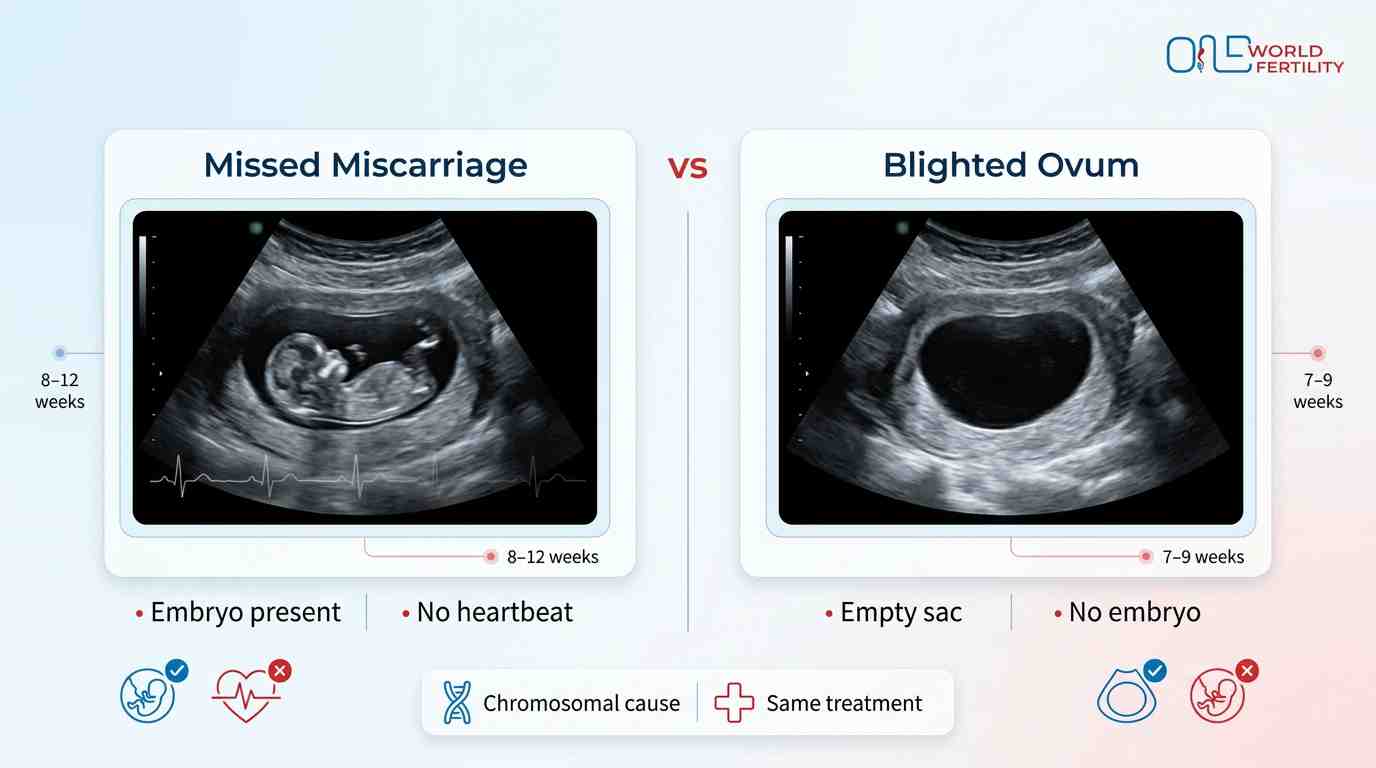
Is a blighted ovum the same as a missed miscarriage?
Not quite, although people often mix them together, especially when looking at scan reports. Anembryonic pregnancy, or a blighted ovum, is when the gestational sac grows but no embryo forms inside it. Ultrasound shows an empty sac with no embryo or yolk sac. Usually picked up between 7 and 9 weeks. What does an empty sac at 8 weeks mean? In most cases, this.
| Basis |
Missed Miscarriage |
Blighted Ovum |
| What developed |
Embryo formed - then stopped |
Sac formed - no embryo ever |
| Scan shows |
Embryo visible, no heartbeat |
Empty sac, no embryo |
| Typically found |
8–12 weeks |
7–9 weeks |
| hCG |
Plateaus or falls |
May still rise initially |
| Cause |
Chromosomal abnormality |
Chromosomal abnormality |
| Treatment |
Expectant, medical, surgical |
Identical |
| On your report |
MMC', 'missed abortion', 'embryonic demise'' |
Blighted ovum', 'anembryonic pregnancy', 'empty sac' |
A missed miscarriage is when an embryo forms, but stops growing. Both are caused by random chromosomal errors. Both are treated identically. Is a blighted ovum my fault? No, and a missed miscarriage isn't either. Both happen by chance during cell division. You didn't do anything to trigger this.
What Causes a Missed Abortion? Why It Happens
Why do missed miscarriages happen? It's usually the first question, and to be honest, it's the hardest one to deal with.
The truth is that in most cases, there isn't one clear cause. And in most cases of missed abortions, there was nothing that could have stopped it. Doctors don't just say it to be nice; evidence demonstrates that it's true.
What is the most common cause of a missed miscarriage?
The most common cause of a missed miscarriage is chromosomal abnormality. About 50% of all miscarriages arise because of random error during fertilisation or early cell division. Not passed down nor partner caused it. A random event at the cellular level that can't be foreseen or stopped.
Here's what else could be a reason for a missed miscarriage and what it really implies for you:
| Cause |
How Common |
Can It Be Prevented? |
What It Means for You |
| Chromosomal abnormalities |
~50% of all miscarriages |
No, happens by chance |
Most common cause and not inherited |
| Low progesterone |
Significant cause |
Partially, progesterone support possible |
Testable and supportable in future pregnancies |
| Uterine structural problems |
Less common |
Yes, treatable in many cases |
Asherman's, fibroids, septum, most are correctable |
| Thyroid, diabetes, PCOS |
Identifiable in some cases |
Yes, with proper management |
Uncontrolled conditions increase risk, both manageable |
| Antiphospholipid syndrome (APS) |
Key factor in recurrent miscarriage |
Yes, with treatment |
Treatable with low-dose aspirin and heparin |
| Age-related egg quality |
Rises after 35, significantly after 40 |
Not reversible |
Higher chromosomal error risk, PGT-A can help in IVF |
| Severe infection |
Rare |
Partially |
Listeria, rubella, rare but identifiable |
| Stress, sex, exercise, travel |
Not a cause |
N/A |
No evidence links these to miscarriage, not your fault |
Can Stress Cause a Missed Miscarriage?
No. Stress does not cause a missed miscarriage. Neither does sex, exercise, travel, or lifting something heavy.
There is no scientific evidence connecting any of them to pregnancy loss, none. But these are the first things people think are their fault. Please don't do it.
It wasn't that, no matter what you're thinking about right now.
A missed abortion happens because of a random chromosomal event, completely outside your control. You did not cause this. You could not have stopped it.
Signs and Symptoms of a Missed Abortion - What to Look For
What are the signs of a missed miscarriage? Most people expect a clear answer, and the reality catches them off guard. There are often no signs at all. That's exactly why it's called a silent miscarriage. The pregnancy has stopped developing, but the body hasn't caught up. No bleeding, no cramping, no warning. Just a routine scan that changes everything. What does a missed miscarriage feel like? For most people, nothing different. And that's what makes it so hard to process.
How Can You Tell If You Have a Missed Miscarriage?
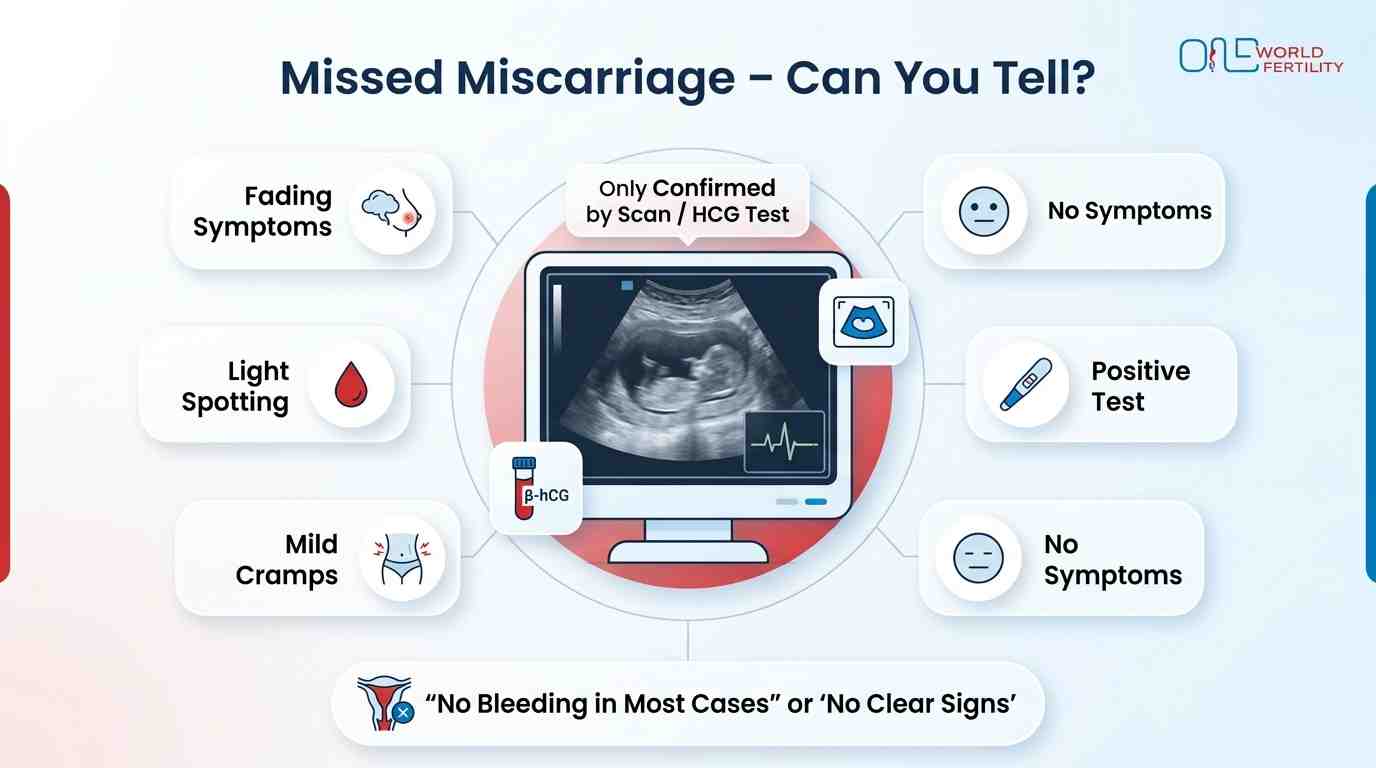
You usually can't, unless you have a scan. So, learn which sign suggests a missed abortion here:
- Fading nausea or breast tenderness - If your hCG levels decline, your nausea or breast pain may go away. But a lot of folks still have all of their symptoms weeks after a miscarriage, so this doesn't prove anything by itself.
- Light brown spotting - old blood, not new bleeding. It can show up for a short time, or not at all.
- Mild cramping, no heavy bleeding - Sometimes it happens, but most of the time it doesn't. Mild cramping is also usual in healthy pregnancies.
- Still testing positive - hCG lingers in the bloodstream for days or weeks after the baby dies. A positive test does not mean the pregnancy is still ongoing.
- No symptoms at all - this is the most usual occurrence. Everything seems fine. It's not that you didn't see something; it's just how a missed abortion works.
Do You Bleed With a Missed Miscarriage?
Usually not, and this surprises most people. Can you have a miscarriage without bleeding? Yes, with a missed abortion, that's actually the norm. The cervix stays closed, the body holds on, and there's no heavy bleed or cramping. If you just searched for "no fetal heartbeat but no signs of miscarriage," you're not alone. It describes a missed miscarriage almost exactly. So how can you tell if you have a missed miscarriage? Only through an ultrasound or blood hCG test. There is no symptom checklist. There is no way to feel it coming.
Every symptom listed above can also appear in a completely healthy pregnancy. Only a scan or blood test can confirm a missed miscarriage. If something feels off, call your doctor.
How Is a Missed Abortion Diagnosed? Tests and Confirmation
Ultrasound, blood testing, or a combination of the two are the main techniques of missed miscarriage diagnosis. But before we get into the details, there's something vital to know. One scan is rarely enough to confirm a diagnosis of a missed miscarriage. Before telling you anything for sure, doctors nearly always do the test again. There is a very excellent reason for this.
Ultrasound For Missed Miscarriage - The First Step
Ultrasound is the best way to find out if a woman has had a missed abortion. A transvaginal ultrasound (TVS) is the best way to do this in the first trimester. At early stages, it shows a considerably clearer picture than an external scan. What doctors want to find:
- A fetal heartbeat (cardiac activity)
-
A visible fetal pole
- Gestational sac size and shape
- Yolk sac appearance
You can usually see a heartbeat on TVS between 6 and 6.5 weeks. Before that time, you might not be able to see a heartbeat even if the pregnancy is going well. This is why time is so important.
Why Your Doctor Might Ask You to Come Back
How long can a missed abortion go undetected? Sometimes weeks, because the measurements have to reach specific thresholds before a diagnosis can be confirmed. This isn't being unsure. It's exactness.
Here are the exact clinical criteria doctors use, based on RCOG and NICE guidelines:
Finding on Scan
|
Diagnostic Threshold
|
What It Means
|
Gestational sac, no embryo (blighted ovum)
|
Sac diameter ≥ 25mm, no embryo visible
|
Consistent with anembryonic pregnancy, if smaller, embryo may just not be visible yet
|
Embryo/fetal pole, no heartbeat
|
Crown-rump length (CRL) ≥ 7mm, no cardiac activity
|
Missed miscarriage — if CRL < 7mm, heartbeat may not be detectable yet in a healthy pregnancy
|
Sac with no yolk sac
|
Sac diameter ≥ 8–10mm, no yolk sac
|
Suspicious, but not confirmatory alone
|
No growth between scans
|
Same measurements on repeat scan 7–14 days later
|
Confirms developmental arrest
|
So when your doctor says, "I'll see you again in a week" they aren't ignoring you. They're following clinical recommendations that were meant to stop misdiagnosis. It would be a big mistake for a doctor to say that a missed miscarriage was real too soon in what turns out to be a continuing pregnancy. The wait is hard, but it's for your own good.
If you've been asked to return for a repeat scan, you are in safe hands. This is the right clinical approach.
hCG Blood Tests - What Your Hormone Levels Can Tell You
Will hCG levels rise with a missed miscarriage? No, and that's exactly the point.
In a healthy early pregnancy, hCG levels usually increase by 53–66% every 2 days. In a missed abortion, levels stay the same or go down instead of going up at the expected rate.
This is why doctors undertake serial hCG testing, which involves two blood draws taken 48 hours apart. The difference between the two tests is what matters, not the number itself.
Some things you should know:
-
A positive pregnancy test does not mean the pregnancy is continuing. hCG lingers in the body for days, and sometimes even weeks, after the fetus dies. A home urine test can't tell you what's going on.
- Blood hCG testing is most useful when the pregnancy is less than 7 weeks along and ultrasound results aren't enough on their own.
- hCG not doubling in early pregnancy is one of the clearest indicators of a non-viable pregnancy, but serial measurement is always needed. A single reading tells doctors very little.
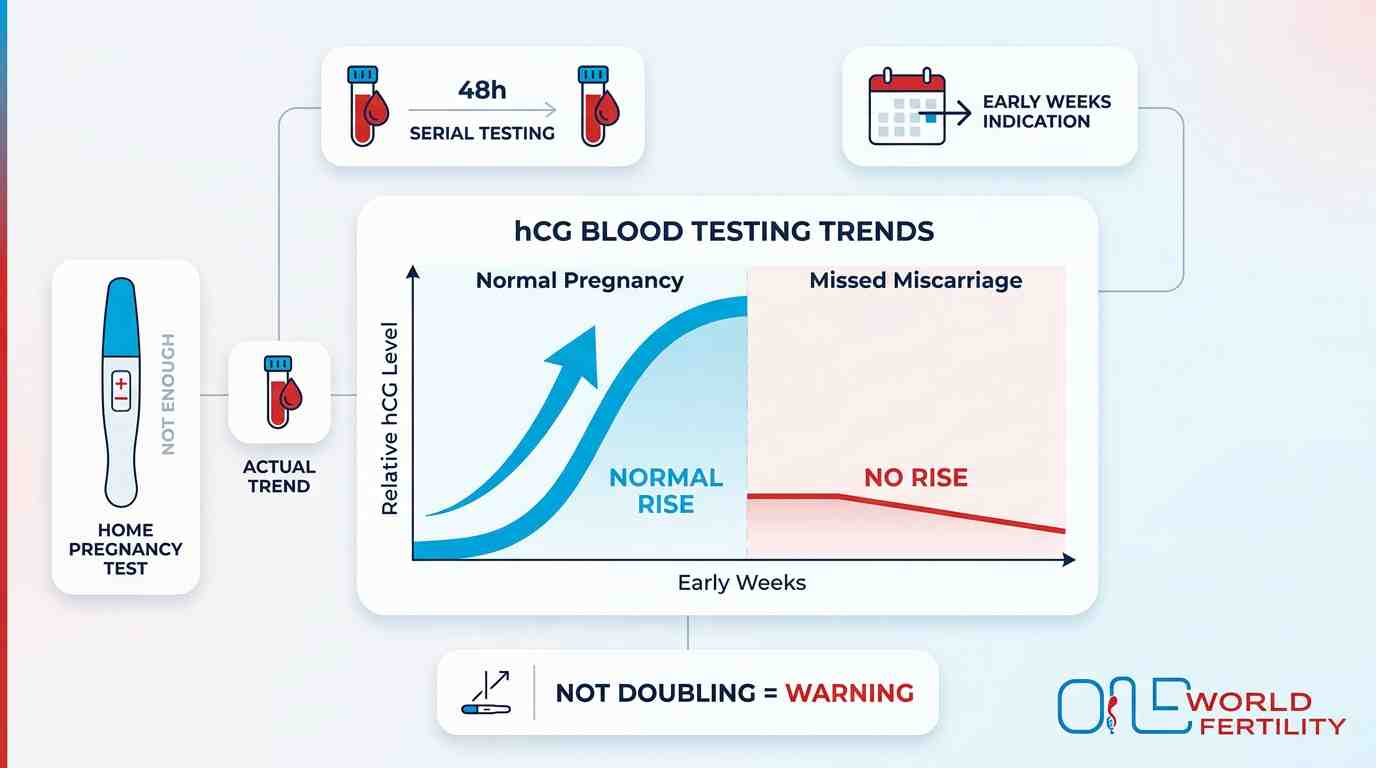
A positive home pregnancy test after a potential missed miscarriage does not confirm the pregnancy is okay. A scan or a series of blood hCG tests are the only ways to find out what's really going on. If you're worried, get in touch with your doctor or the early pregnancy unit right away.
Treatment Options for a Missed Abortion - Your Choices Explained
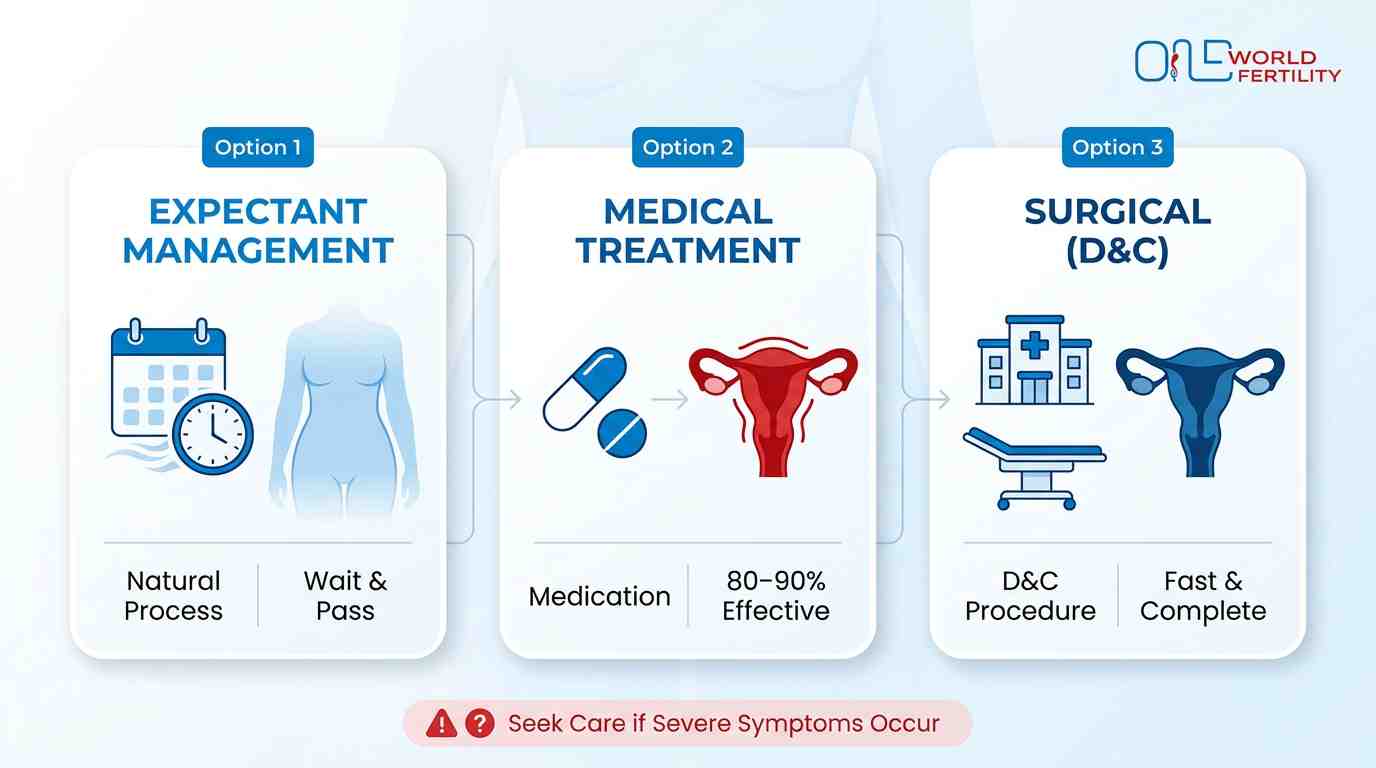
Once a missed abortion is confirmed, you'll be given a real choice. How is a missed miscarriage treated? You have three choices, and a good doctor won't push you to choose one. The best missed miscarriage treatment depends on how far along the pregnancy was, your medical history, and what feels right for you. Here's what each option for missed miscarriage really means, in plain language, without any medical terms.
Before Anything Else - What to Prepare for missed miscarriage
No matter what missed miscarriage treatment option you choose, being ready really helps. Here's what you need to get ready for, whether you're getting ready for expectant management, medicinal pills, or a D&C:
Preparation
|
Expectant
|
Medical (Misoprostol)
|
Surgical (D&C)
|
Support person
|
Strongly recommended
|
Essential, have someone with you
|
Essential, you cannot drive after anaesthesia
|
Sanitary protection
|
Heavy overnight pads, no tampons
|
Several packets of heavy pads, no tampons
|
Light pads for post-procedure spotting
|
Pain relief
|
Ibuprofen or paracetamol, discuss dose first
|
Ask your doctor to prescribe anti-cramp medication before, don't wait until the pain starts
|
Managed during surgery, paracetamol usually enough after
|
Heat pad
|
Helpful if cramping begins
|
Place on abdomen, significantly reduces cramping
|
Not usually needed
|
Food and drink
|
Eat normally
|
Light meal beforehand, nausea is common
|
Nil by mouth from midnight if under general anaesthesia
|
Transport
|
No hospital visit initially
|
Arrange a lift home, don't drive yourself
|
Someone must drive you home, non-negotiable after anaesthesia
|
Follow-up scan
|
Book at diagnosis
|
Book when you take the medication
|
Usually arranged by hospital before discharge
|
Preparing practically doesn't mean you aren't grieving. It means you're taking care of yourself, which is exactly what you deserve. If you're unsure about anything here, call your clinic before your treatment date. There are no unnecessary questions when it comes to this.
Option 1 - Expectant Management for Missed Miscarriage
Expectant management means exactly what it sounds like waiting. No medication, no surgery. The body is given the chance to recognise the loss and pass the pregnancy tissue naturally.
More than 65% of women remove the tissue within 2 weeks. When it happens, you can expect a lot of cramps and bleeding that is heavier than usual, and sometimes there are clots. A follow-up scan shows that the uterus is now empty. Will a missed miscarriage eventually pass on its own? In most cases, yes, but it takes time, and not everyone is comfortable with that uncertainty. That's completely valid. Expectant management for missed miscarriage is a genuine, medically supported choice, not just waiting and hoping.
This choice works best when:
- You're medically stable with no signs of infection.
- The pregnancy is less than 12 weeks along.
- You prefer a natural process and are comfortable waiting.
It's not right when:
- There are signs of infection or heavy active bleeding
- The pregnancy is beyond 12–14 weeks
- You'd prefer a faster, more certain resolution
Option 2 - Medical Treatment for Missed Miscarriage (Tablets and Medication)
If you miss a miscarriage, Medical treatment for a missed miscarriage employs medication to start contractions in the uterus and finish the process, no surgery involved. It seems like the right middle ground between waiting and having a procedure for a lot of folks.
What are the pills for a missed miscarriage? The WHO 2022 guidelines recommend a two-medicine combination:
- Mifepristone 200mg - taken orally first
- Misoprostol 800mcg - taken at least 24 hours later, buccally, sublingually, or vaginally
Before starting any medication, always discuss the right regimen for your situation with your doctor - dosage, timing, and what to expect should be confirmed with your care team first.
This mifepristone and misoprostol for missed miscarriage combination achieves 80–90% complete uterine evacuation, which is far better than misoprostol alone.
What does misoprostol actually feel like? A lot of cramping, heavy bleeding, nausea, chills, and maybe diarrhea, usually for 4 to 8 hours. Before it starts, get some pain medication and a hot pad. Don't wait until the cramps start.
- If mifepristone isn't available - Misoprostol 800mcg by itself is the next best thing. It doesn't function as well, but it works in most circumstances. You might need to take another dose at 9 weeks or later.
- If misoprostol fails - The next step is surgery (D&C). It's not uncommon and not a failure; it's just what happens next.
Seek emergency care if you're soaking more than 2 pads per hour for 2 consecutive hours, have a fever above 38°C, severe abdominal pain, or foul-smelling discharge.
Option 3 - Surgical Management (D&C for Missed Miscarriage)
A D&C for a missed miscarriage is a quick surgery in which the cervix is softly opened, and the pregnant tissue is sucked out while the patient is asleep. Usually, it takes 15 to 30 minutes and is done in one day. You go home the same day.It carries the highest success rate of all three treatment options, with near-complete uterine evacuation in the vast majority of cases.
When is a D&C recommended?
- A pregnancy that lasts longer than 12–14 weeks
- Medical management has failed or is insufficient
- A serious infection or profuse bleeding that needs immediate attention
- Personal preference for the quickest and most certain solution
What does D&C recovery look like?
- Light spotting for one to two weeks
- Returns every 4 to 6 weeks
- Back to normal life in two to three days
- It takes time for everyone to heal emotionally, and that time varies
What to prepare for a D&C? Three things you can't change: have someone drive you home, follow the nil-by-mouth guidelines from midnight, and make sure your follow-up scan is scheduled before you leave the hospital.
How To Recovery After a Missed Abortion?
Missed miscarriage recovery isn't just physical, it's also mental. This is what you may expect from your body and what you should let yourself feel.
Physical Recovery After a Missed Abortion - What to Expect
How long does it take to recover from a missed miscarriage? Depending on your treatment, the physical side gets better faster than most people think. After expectant or medical management:
- Light spotting for 1 to 2 weeks after the tissue passes
- Cramping during the process, but it goes away when it's done
- Fatigue is common for several days - rest without guilt
After a D&C:
- Light spotting for one to two weeks
- Mild cramps that last for 24 to 48 hours
- Most people can go back to their daily activities in 2 to 3 days
When does your period return after a missed miscarriage? Usually, this happens 4 to 6 weeks after the body has completely emptied, when hormones start to reset. How soon does fertility return? Ovulation can come back as soon as two weeks following a complete evacuation, which is sooner than most people think. For at least two weeks after treatment, stay away from tampons and sex. This is when the danger of infection is the greatest.
Seek emergency care for heavy bleeding soaking more than 2 pads per hour, fever, severe pelvic pain, or foul-smelling discharge after treatment.
Can You Get Pregnant After a Missed Miscarriage?
Yes, and the outlook is genuinely positive.
Around 87% of women who experience one miscarriage go on to have a healthy pregnancy. A single missed miscarriage does not significantly increase your risk of having another. Chances of pregnancy after a missed miscarriage are strong. For most people, this is a painful chapter within a story that continues.
How long after a missed miscarriage should you wait to try again? Most doctors recommend waiting for at least one normal period to return first, confirming the uterus has fully recovered and making pregnancy dating easier. Emotionally, only you know when you're ready.
Here's what the recurrent miscarriage risk picture looks like:
-
One missed miscarriage - risk of a second is around 14–21%, roughly in line with the general population. Not significantly higher than before.
- Two consecutive losses - risk increases slightly. Investigation may be considered depending on the history.
-
Three or more losses (recurrent miscarriage) - specialist investigation is recommended. Chromosomal testing, uterine assessment, and immune and clotting factor screening, answers are available, and so is treatment.
Wanting to try again is not forgetting. It's moving forward , and that's allowed.
You Are Not Alone in This
A missed miscarriage is one of the most unexpected and quiet losses, and it's also one of the toughest to deal with. But you should know that it wasn't your fault. It was never your fault.You have real treatment options, real support, and real reason for hope. Most women go on to have healthy pregnancies after a missed abortion. This is not the end of your story.It takes time to heal, both physically and mentally. Be kind and patient with yourself.
If you've been told about a missed miscarriage diagnosis or are worried about your pregnancy, our staff is here to help. Call us, WhatsApp us, or make an appointment in Oneworld Fertility.
Frequently Asked Questions
Yes, and the future seems very bright. About 87% of women who experience one miscarriage go on to have a healthy pregnancy. Most doctors say to wait at least one regular period before trying again, but fertility can come back as soon as two weeks after treatment.
Usually, 4 to 6 weeks after the uterus has been completely emptied, the hormones from pregnancy have passed, and the body's cycle has started over.
Most people get better in 2 to 3 weeks. For the first week or two after treatment, you may notice some light spotting. Your period should come back between four to six weeks. It takes longer to heal emotionally, and there is no defined time frame for it.
There are three types of management: expectant management (waiting for natural passage), medicinal management (using mifepristone and misoprostol pills), and surgical management (D&C). All three are medically sound. Always talk to your doctor first about what is best for you based on your age, medical history, and personal preferences.
No. If you're pregnant and healthy, your hCG levels should go up by at least 53–66% every 48 hours. In a missed abortion, the levels stay the same or go down instead. A positive home pregnancy test doesn't mean that the pregnancy is still going on. hCG lingers in the body for days or weeks after the fetus dies.
By using ultrasound, repeated hCG blood tests, or both. The most accurate way to do it in the first trimester is using a transvaginal ultrasound. Before confirming the diagnosis, doctors have to meet certain clinical measurement thresholds. This is why a repeat scan is often needed a week later.
The most common reason is a random chromosomal defect that happens during fertilization or early cell division. This is the cause of about half of all losses. Other things that can cause this are insufficient progesterone, difficulties with the structure of the uterus, thyroid disorders, and antiphospholipid syndrome. Stress, exercise, and sex do not lead to missed miscarriage.
Yes, and this is normal for a missed abortion. The cervix stays closed, and the body keeps the tissue from the pregnancy. There is no blood, cramps, or anything else that fits what most people think will happen.
That's why it's termed a "silent miscarriage": most people don't experience any indicators at all. Some people note that their nausea or breast discomfort is becoming better, that they have light brown spotting, or that they are having moderate cramps. But most people only find out when they get a routine ultrasound and don't hear a heartbeat.
A missed abortion is a medical word for a missed miscarriage, which is when the embryo or baby has ceased growing but the body hasn't realized it yet. The cervix stays closed, there is no bleeding, and the hormones that cause pregnancy keep working. Some people call it a silent miscarriage or MMC.