
IVF Cost in France: What You Pay, What the State Covers
by:One World Fertility
|
onApr 3, 2026, 12:04 PM
In:World
|
TypeArticle
The IVF cost in France is one of the most misunderstood aspects of fertility treatment. You Googled it, saw a figure somewhere between €3,500 and €8,000, and immediately thought, does any of this apply to me? If you are a French resident and are a member of Sécurité Sociale, the answer can be: nearly nothing out of pocket. If you're searching for IVF in France as a foreigner, you'll likely have to pay the full private fee. That gap isn't a loophole. The system is working exactly as it should.
By the end of this guide, you'll know your exact category, how much IVF costs in France, including the cost of private cycles, what the government covers, how many funded attempts you get, and the age limits. You'll also find the success rate context, because cost without odds is just a figure that doesn't represent anything.
You're at the perfect place, whether you're a resident with a confused clinic quote or a couple thinking about moving to France from another country. Let's begin with the number, which is where everyone starts and figure this out together.
How Much Does IVF Cost in France? The Number You Came For
First things first, here is the number. The rest of this article will show you how your real IVF cost in France may look very different from this.
The IVF price in France can be as little as €2,000 for a short cycle or as much as €12,000 for donor egg treatment. But that difference only makes sense if you know which column relates to you: private pay or state coverage. Here are all the numbers next to each other.
IVF Cost in France - Full Treatment Price Table
| Treatment |
Private Cost (€) |
State Covered |
Who Needs It |
| First consultation + referral |
€150-€300 |
Free if enrolled |
Everyone |
| Fertility diagnostic workup |
€500-€1,500 |
Free if enrolled |
Everyone |
| IUI - artificial insemination |
€300-€800/cycle |
Free up to 6 cycles |
Mild infertility, first-line |
| Standard IVF (own eggs + sperm) |
€3,500-€5,500 |
Free up to 4 cycles |
Most couples |
| IVF + ICSI |
€4,000-€6,500 |
Free up to 4 cycles |
Male factor infertility |
| IVF with donor egg |
€6,000-€12,000 |
Partial, waiting list |
Low AMH, age 38+, poor egg quality |
| IVF with donor sperm |
€3,800-€6,000 |
Covered if medically indicated |
Azoospermia, single women |
| Mini IVF / Natural cycle IVF |
€2,000–€4,000 |
Not covered |
Poor responders, low AMH |
| Frozen embryo transfer (FET) |
€1,500-€3,000 |
Within 4-cycle allowance |
Second attempt |
| Egg freezing (social) |
€2,500–€4,000 |
Not covered |
Fertility preservation |
| Ovarian stimulation medicines |
€800-€2,500 |
Covered if eligible |
All IVF patients |
| Annual egg/sperm storage |
€500-€1,000 |
Not covered |
Ongoing cryostorage |
Read this first before you make a budget: Most clinics give you the IVF fee in France only. Medicines, monitoring scans, and anaesthesia are usually charged separately, which might add €800-€2,500 to your final payment. That's not a hidden charge. It's just how private fertility billing works. Always ask for a full itemised written quote before you sign anything.
Now that you have the numbers, the next question that practically everyone asks is, "can France actually pay for this?" Yes, for many people who live there. But most individuals don't know how specific the eligibility rules are. Let's find out who is eligible and who isn't.
Is IVF Free in France? Who the State Actually Covers
Yes, but only if you check every box. Whether that yes applies to you comes down to one question most articles skip entirely. Let's settle it now.
Does France really pay for IVF? Yes. IVF France Sécurité Sociale is one of the best state-funded fertility treatment programs in the world. It covers up to four full cycles, including consultations, scans, egg retrieval, and medications. All free for eligible patients. But eligible is doing a lot of work in that sentence.
Eligibility Checklist: Do You Qualify for IVF Coverage in France?
- Egg retrieval is only possible for those under 43; frozen embryo transfers can continue until age 45.
- Enrolled in French Sécurité Sociale as a worker, resident, or via PUMA.
- Confirmed infertility diagnosis, OR a single woman or a same-sex couple (legal since 2021).
- Treatment at a certified AMP centre (Assistance Médicale à la Procréation).
- Fewer than 4 cycles reaching embryo transfer or 6 IUI cycles If you miss one box, you lose all of your coverage.
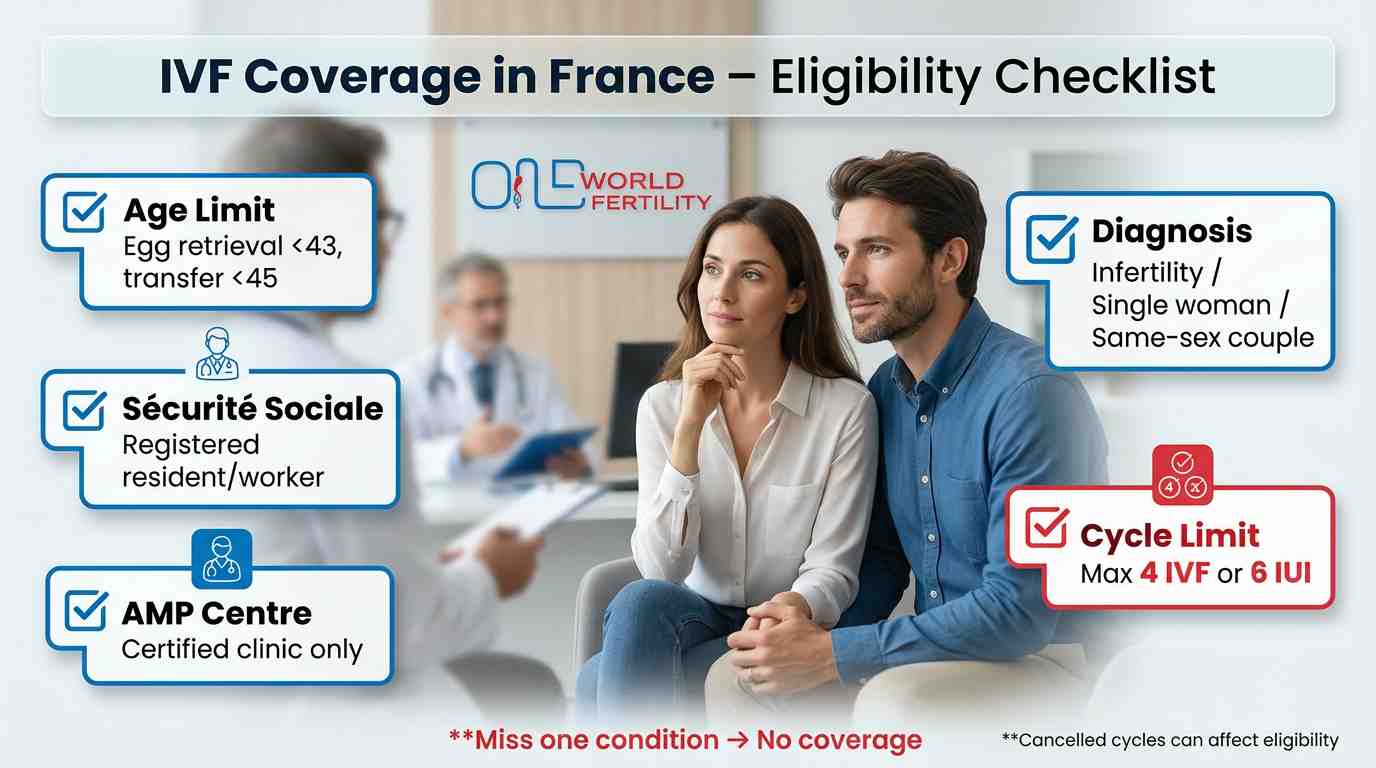
One item that makes a big difference for cancelled cycles
One detail that changes everything for cancelled cycles
The 4-cycle limit only counts if you get to the point of transferring an embryo. Cancelled early because of a lack of reaction or embryos? That round usually doesn't count toward your total. A modest but important alleviation for many patients.
Living in France but not French? PUMA covers you
If you live in France for three months, even if you don't work, you can register with PUMA (Protection Universelle Maladie) and get the same IVF France CPAM reimbursement as any French citizen. Tip: It can take months for the Carte Vitale to be processed. Apply right away and keep all of your receipts (feuille de soins). Once your number is activated, you can get money back for things you bought in the past.
The 2021 law change, if you were told no before
As of September 2021, single women IVF France and lesbian couples have the same legal right to state-funded IVF in France as straight couples. Same centres, same cycles, same coverage. The law has changed since the clinic last informed you of anything else.
Who is NOT covered in IVF France
- Medical tourists visiting France solely for IVF
- Women who have their eggs taken out at 43 or older
- Couples with no medical infertility diagnosis
- Anyone seeking surrogacy in France is illegal without exception
- Social egg freezing outside the 29–37 age window
Now that you know if France will pay for your treatment, let's look at what that treatment is and how much it costs when it doesn't.
Every IVF Treatment Available in France: What Each One Costs
IVF isn't necessary for every couple. Many people don't even start there, though. Here is a list of all the fertility treatment option in France, along with what they are, who they are for, and how much they cost.
IUI France - Try This Before You Jump to IVF
Most doctors recommend IUI (Intrauterine Insemination) in France as the first choice because it is less invasive and costs less. At ovulation, processed sperm are put right into the uterus. No surgery or any egg collection. It's better for your body and your wallet.
IUI France cost: €300-€800 per cycle
The French government covers up to 6 cycles for free if you are eligible, as we discussed earlier. It works well for mild male factor, unexplained infertility, single women using donor sperm, and same-sex couples. The success rate is 10% to 20% every cycle, which is lower than IVF, but the low cost and ease of use make it a good starting step for many people. Your doctor will skip IUI and move straight to IVF if your tubes are obstructed or the quality of your sperm is very low.
Standard IVF - Where Most Couples Begin
Eggs are stimulated, removed, fertilised in a lab, and then returned. The average cost of IVF in France is between €3,500 to €5,500 per cycle, and drugs are charged separately. The state paid for up to four cycles.
The IVF success rates in France for women under 35 are 40–50%, dropping steadily after that. If your ovarian reserve is healthy, this is your most straightforward path forward.
ICSI - When Sperm Needs Extra Help
ICSI France cost is €4,000–€6,500. Instead of leaving sperm and egg to meet naturally in a dish, a single sperm is injected directly into each egg. It completely skips low count, poor motility, excessive sperm DNA fragmentation, and azoospermia. If your partner's semen analysis shows any problems, your doctor will almost certainly recommend ICSI. It's not the last option. This is the right tool.
Donor Egg IVF France - For When Your Own Eggs Aren't the Answer
The cost of donor egg IVF in France ranges from €6,000 to €12,000. Eggs from a 21-37 year-old anonymous donor who has been checked and fertilised with your partner's sperm. Success rate: 55-70%, which is the best you can get at any age. Best for women over 38 with low AMH, poor egg quality, or early ovarian insufficiency.
One honest heads-up: it can take 12 to 24 months to get on a donor egg waiting list in France. Instead, many couples go to Spain or Belgium. French CPAM can still pay for some of your costs abroad, so it's a good idea to check before you book anything.
Donor Sperm IVF - For Azoospermia and Single Women
Donor sperm IVF in France costs between €3,800 and €6,000. State covered since 2021 for single women and medically indicated cases. Be aware, CECOS waiting lists currently run 6-18 months due to France's known sperm donor shortage.
Frozen Embryo Transfer (FET) - Second Attempt at Lower Cost
Frozen embryo transfer France (FET) - It costs between €1,500 and €3,000 to transplant frozen embryos in France. No need for more stimulation. Counts as part of your 4-cycle allowance. The second try is the cheapest.
Mini IVF / Natural Cycle IVF - Lower Cost, Lower Stimulation
Mini IVF France costs between €2,000 to €4,000. Less stimulation, lower cost, not subsidised by the state. Best for people whose ovaries don't respond well to treatment.
Egg Freezing - Social and Medical Fertility Preservation
Social egg freezing in France costs between €2,500 and €4,000 to get back, plus €500 to €1,000 a year to store them. Medical egg freezing, before chemotherapy, for example, is state covered. Social egg freezing in France is legal since 2021 but not funded by the state.
Now you know what treatments exist, but what actually happens at each stage, and what does each step cost you?
The IVF Process in France - Step by Step With Cost at Each Stage
You now know which treatment is best for you. But knowing the name of a treatment and what it really does are two very different things. What do they check first? When do the shots begin? What does the clinic charge for each step, and which costs do they quietly leave off the quote?
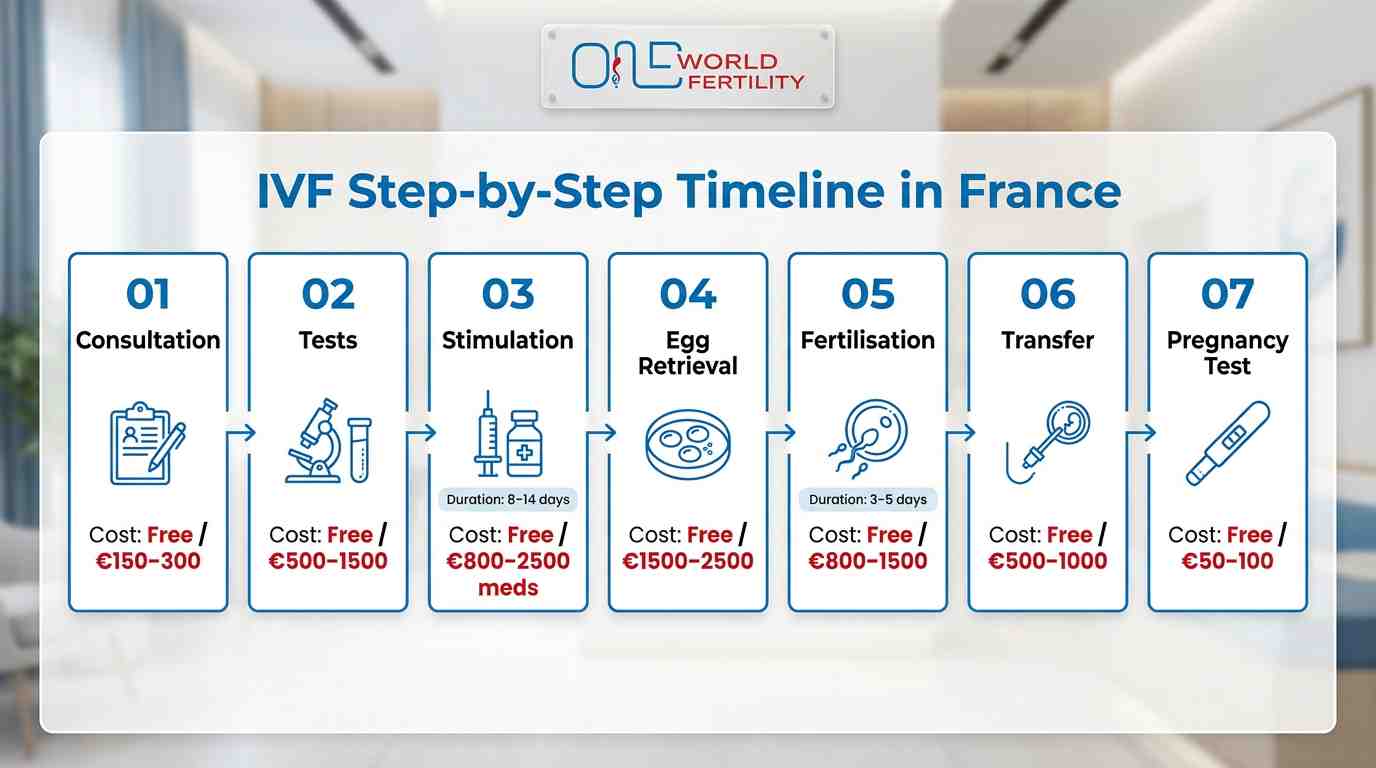
This is all the information you need to know before your first session. The whole IVF process in France, step by step, including the exact expenses at each step.
Step 1 - First Consultation and Referral
Your doctor will first send you to a certified AMP centre. One meeting. A professional looks into your background and talks to you about your choices. Cost: Free if covered; €150–€300 for private care.
Write your questions down before you go. This appointment carries more weight than it looks.
Step 2 - Fertility Diagnostic Workup
Before anything begins, both partners are tested. The whole view includes AMH, FSH, antral follicle count, semen analysis in France, and DNA fragmentation if necessary.
Cost: Free if covered; €500–€1,500 for private; results in 1–2 weeks.
Many couples say they feel a sense of unusual relief after this stage. It's easier to know than to guess.
Step 3 - Ovarian Stimulation (8-14 Days)
Hormone shots every day make your ovaries work harder. Every 2 to 3 days, monitoring scans check on the growth of the follicles. Cost: Free if covered; €800–€2,500 for drugs and €300–€600 for private scans.
Warning: there may be hidden costs. Ovarian stimulation medicine costs in France are nearly always not included in the main clinic price. In writing, please confirm if the medicine is included or billed separately.
Most patients are amazed at how quickly the injections become a part of their daily lives. By day 3, it's just part of the morning.
Step 4 - Egg Retrieval (30 Minutes)
Eggs are taken out of the body with ultrasound-guided aspiration while the person is lightly sedated. Discharge on the same day. Back home in a few hours.
Price: Free if covered; €1,500–€2,500 for private anesthesia. The anxiety before egg retrieval in France is nearly always worse than the actual process.
Step 5 - Fertilisation and Embryo Culture (3-5 Days)
In the lab, eggs are fertilized with sperm from a male partner or a donor. For 3 to 5 days, embryos are watched closely. Many IVF clinics in France offer AI embryo grading through Embryoscope as an extra service.
Cost: Free if covered; €800–€1,500 + €300–€700 for private AI grading.
Important reminder about the law in France: There are strict laws regarding embryo freezing in France. Only unfertilized eggs can be frozen. If your cycle doesn't work, you'll need to do another round of stimulation. French law does not allow for the freezing of embryos for backup.
Step 6 - Embryo Transfer (15 Minutes)
The best embryo is placed into the uterus via a thin catheter. No surgery, no stitches, minimal discomfort.
Price: Free if covered; €500 to €1,000 for private Fifteen minutes that hold everything you've worked for. Give yourself permission to feel whatever comes up - hope, fear, relief. All of it is valid.
Step 7 - Beta hCG Pregnancy Test (10-14 Days Later)
A simple blood test can tell you if implantation happened. Results on the same day. Price: Free if covered; €50–€100 privately.
Now that you know every phase, let's talk about what else you can do to your cycle to make it more likely to work.
Advanced IVF Add-Ons in France: What They Cost and Who Needs Them
None of these is mandatory. A good fertility doctor in France recommends only what your specific situation calls for. Here is what each one does, who actually needs it, and whether it is worth the extra cost.
| Add-On |
What It Does |
Cost (€) |
State Covered |
Who Needs It |
| AI Embryo Grading / Embryoscope |
Scores embryos using AI - improves selection |
€300-€700 |
No |
Women 35+, 3+ embryos, previous failed transfer |
| PGT-A Genetic Testing |
Screens embryos for chromosomal abnormalities |
€1,500-€3,000 |
Strict cases only |
Recurrent miscarriage, age 38+, repeated failures |
| Laser Assisted Hatching France |
Helps embryo break through outer shell |
€200-€400 |
No |
Frozen embryos, women over 37, thick zona pellucida |
| ERA Test France |
Finds your personal implantation window |
€500-€800 |
No |
Repeated failed transfers despite good embryos |
| IMSI France |
Sperm selected at 6,000x magnification |
€300-€500 |
No |
High DNA fragmentation, previous ICSI failures |
| Blastocyst Culture Day 5 |
Embryo grown to day 5 before transfer |
€200-€400 |
Partially |
Multiple embryos, women 35+, previous day 3 failures |
AI Embryo Grading France - Is It Worth It?
It's like getting a second opinion, but from an algorithm that never gets tired.During the culturing stage, a time-lapse camera captures images of your embryos every 10 minutes. An AI embryo grading system analyses thousands of data points and assigns each embryo a grade from 0 to 99 based on its likelihood of implanting. Available at the top French IVF centres. AI embryo grading in France costs: €300-€700. Not covered by Sécurité Sociale.
Does it actually work? Studies at French ART centres show a 5-15% improvement in implantation rates. Less guesswork, more data.If you have three or more embryos to choose from, the honest answer is to ask about Embryoscope IVF France. If you have one embryo, you've already made your choice. The add-on doesn't affect anything.
Now you know what's out there and, more importantly, what you really need. But here's what most couples outside of France want to know right now: how does all of this compare to other countries? Let's see what happens next.
IVF Cost Comparison: France vs India vs UK vs USA vs Australia
Once you know if you are eligible, the next question is nearly always, "Am I in the right country for this?" The IVF cost varies widely from one country to another. The USA IVF cost is almost 4 times that in France. IVF in India costs very little. The NHS IVF funding varies by region. Australia's Medicare rebate helps, but never covers everything.
France is in a class of its own for people who live there and meet certain requirements. Here are all the numbers next to each other.
Standard IVF Per Cycle (Own Eggs + Sperm)
| Country |
Private Cost Per Cycle |
State Coverage |
Cycles Covered by Govt |
Age Limit |
| France |
€3,500-€8,000 |
Yes, Sécurité Sociale |
Up to 4 |
Under 43 |
| India |
€1,100-€2,800 |
None |
0 | Under 50 (Female) / 55 (Male) |
| UK |
€5,800-€11,600 |
Yes, NHS (partial) |
Up to 3 (varies) |
Under 40 |
| Australia |
€5,400-€8,700 |
Partial, Medicare rebate |
Rebate only |
No strict limit |
| USA |
€13,800-€27,600 |
Rare, 22 states only |
0-3 (state dependent) |
Varies |
All Major Treatments Across All 5 Countries
| Treatment |
France (€) |
India (€) |
UK (€) |
Australia (€) |
USA (€) |
| Standard IVF |
€3,500-€8,000 |
€1,100-€2,800 |
€5,800-€11,600 |
€5,400-€8,700 |
€13,800–€27,600 |
| IVF + ICSI |
€4,000-€6,500 |
€1,300-€2,200 |
€6,900-€13,300 |
€6,300-€9,300 |
€15,600-€30,400 |
| Donor Egg IVF |
€6,000-€12,000 |
€2,200-€3,800 |
€9,200-€17,400 |
€9,000-€15,000 |
€27,600-€55,200 |
| FET |
€1,500-€3,000 |
€330-€660 |
€2,900-€5,800 |
€1,800-€3,000 |
€4,600-€7,400 |
| Stimulation Medicines |
€800-€2,500 |
€330-€880 |
€1,700-€3,500 |
€1,800-€3,000 |
€2,760–€6,450 |
| AI Embryo Grading |
€300-€700 |
€165-€330 |
€460-€930 |
€360-€720 |
€610-€1,100 |
| PGT-A |
€1,500-€3,000 |
€550-€1,300 |
€2,300-€4,600 |
€1,800-€3,600 |
€4,140-€9,200 |
| Annual Storage |
€500-€1,000 |
€110-€165 |
€350-€700 |
€360-€720 |
€460-€1,380 |
So, where does France actually stand? This comparison doesn't matter much if you live in France and are under 43. The state pays. France is the best country in the world for IVF costs, period.
If you're paying privately and not a resident? IVF costs in India are 70-80% lower than in France, yet clinical outcomes are comparable. There are clinics like One World Fertility in India that offer internationally accredited facilities, advanced embryology labs, and AI embryo grading, at a fraction of what France charges for private care.
Affordable doesn't mean compromised here. The UK's NHS IVF funding varies wildly by region. The USA's IVF costs are the highest in the world. IVF in Australia sits in the middle. Medicare helps, but never covers everything. The numbers don't lie. Affordable IVF in Europe starts in France. Affordable IVF with world-class technology starts in India. Let's talk about exactly what France does NOT cover next.
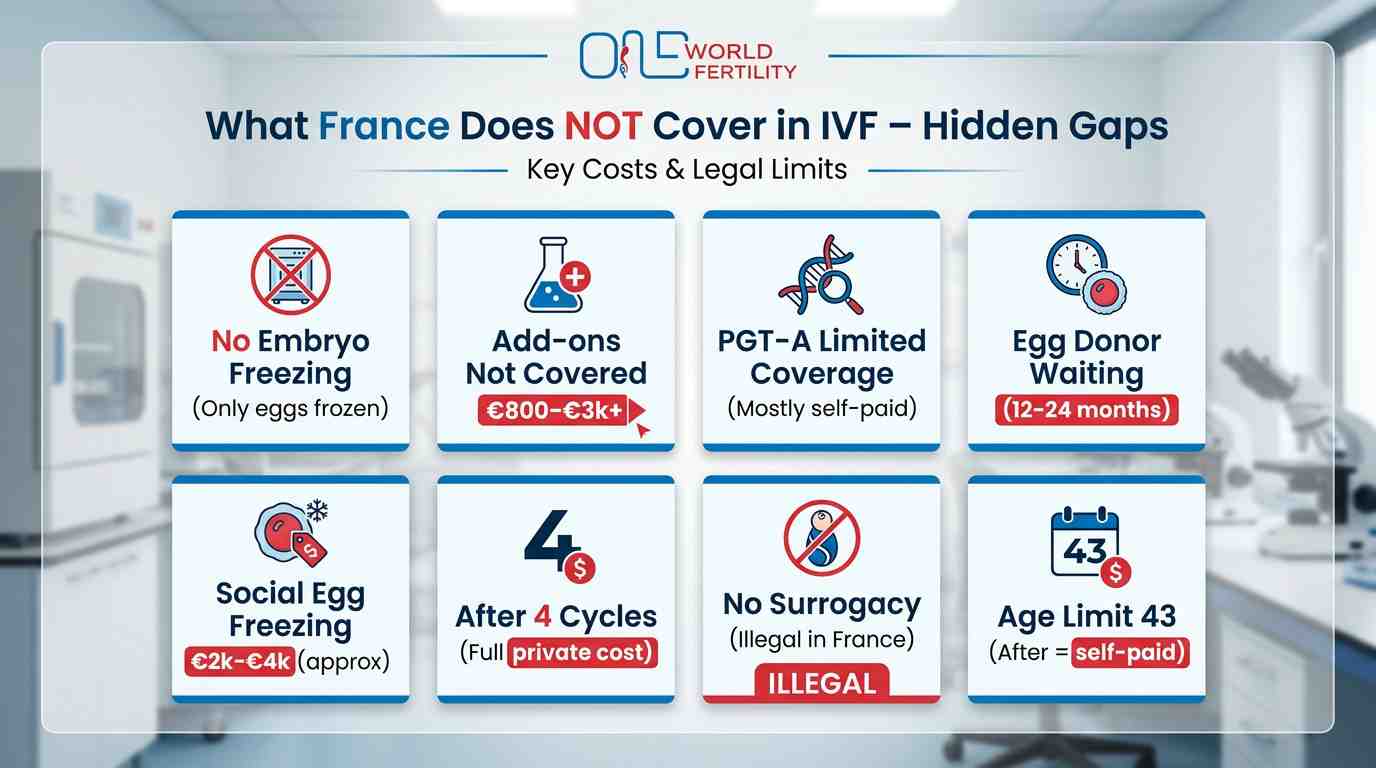
What France Does NOT Cover - The Gaps That Catch Couples Off Guard
In France, state coverage is very good. But it's not all there. These are the gaps that most couples only discover in the middle of treatment. You should know them in advance.
- Embryo freezing is prohibited in France. Only unfertilised eggs can be vitrified. If your first transfer doesn't work, you'll have to start a new stimulation cycle. This is the biggest IVF legal restriction in France and the main difference between IVF in France and in Spain or the UK.
- IVF add-ons are not covered. AI embryo grading, the ERA test, and laser hatching are all additional extras that can silently add €800 to €3,000 to your price.
- PGT-A genetic testing in France is state-funded only in very narrow medical cases. Most couples pay for the whole PGT-A France cost out of their own pockets.
- Donor egg waiting lists last 12 to 24 months. French law says egg donors can't be paid, so there is always an egg donor shortage in France.
- Social egg freezing in France is legal since 2021, but not reimbursed by Sécurité Sociale. If you're freezing eggs for non-medical reasons, the full egg freezing France cost of €2,500–€4,000 comes out of pocket.
- Beyond 4 cycles, all further treatment is at full private IVF cost in France.
- Surrogacy in France is completely illegal, no exceptions.
- IVF France age limit: state coverage stops at 43. Everything after is fully out of pocket.
- Donor identity rights: Since the 2021 French Bioethics Law, donor-conceived children can request their donor's identity when they turn 18. Unlike Spain, anonymity is not permanent here.
Now you know the gaps. But here's what surprises most couples even more than the cost: how long it actually takes to start.
The Waiting Time Reality - What Nobody Tells You Before You Book
State coverage in France is exceptional. The waiting time is not.This is the part most couples discover only after they've already enrolled, and it changes everything. So, how long does it really take? Not weeks. For most people who use the public system, it takes months. Sometimes it takes almost a year for a single shot to start. This is what the timeline really looks like:
| Stage |
Public Clinic Wait |
Private Clinic Wait |
| First consultation |
3–6 months |
2–4 weeks |
| Starting first IVF cycle after workup |
6–12 months |
4–8 weeks |
| Egg donor matching and treatment |
12–24 months |
Not available in France - travel to Spain or Belgium |
| Donor sperm via CECOS |
6–18 months |
Same, no private sperm banking in France |
Why so long? The 2021 French Bioethics Law opened IVF access in France to single women and same-sex couples overnight. There weren't enough public AMP centres to handle this many people. The waitlists grew and haven't recovered since.
Here's what matters most. For anyone over 37, a 6–12 month IVF waiting time in France isn't just frustrating, it's medically significant. Every month, egg quality fluctuates. Let your specialist know right away if time is a factor in your instance. You could want to think about getting private IVF in France or going abroad for treatment.
Before you decide to go the public way, talk to an expert about your timeline. There is a wait. And if you're coming from outside of France, there's one additional thing that no one tells you about until you're already in the room. Next is the problem with language.
IVF in France: Language Barrier Guide for NRIs and International Patients
Most public AMP centres in France operate entirely in French. This is not a little problem for NRI couples, English-speaking expats, and international IVF patients in France. It's a real problem in real life. What this means in real life:
- All of the consent paperwork, test reports, and medicines are in French
- Consultations without an interpreter
- Medication timing is misunderstood, in a cycle where every hour matters
What to do before you make a reservation:
- Before you choose, find out whether there are IVF clinics in France that speak English.
- Ask for consent papers in your language.
- You have the right to know what you are signing. Look at private IVF clinics in Paris. There are IVF clinics in France that have staff who speak more than one language.
- When going to public clinics, use a patient coordinator who speaks two languages.
- For translated questions, WhatsApp or email is far better than the phone.
The language barrier is not a reason to avoid France. It's a reason to choose your clinic carefully and prepare before you walk in. A consultation where you understand 60% of what was said is not enough when you're making decisions about your fertility.
You now know what the language is really like. But if you're going the private route, the following question is easy. How do you really pay for it? Next, let's learn that.
How to Pay for Private IVF in France: Financing, Insurance, and Reimbursement
If you're paying privately, whether you're not yet eligible or need cycles beyond your covered allowance, the cost doesn't have to hit you all at once. Here is every legitimate way to reduce what you actually pay.
- Mutuelle Top-Up Insurance: Most French residents already have a Mutuelle private insurance France alongside Sécurité Sociale. Many Mutuelles cover additional IVF cycles or add-ons that the state doesn't reimburse, sometimes up to €2,000 extra per cycle. Check your policy before treatment starts, not after.
- CPAM Partial Reimbursement for Treatment: Abroad Travelling to Spain or Belgium for donor egg IVF because of France's 12–24 month waiting lists? If you live in France, your CPAM IVF reimbursement may cover part of the cost at the French national rate, even if you get treatment overseas. Before you book anything, write to your CPAM and ask.
- Clinic Payment Plans: Most private IVF clinics in France let you pay off your bill over 12 to 24 months with no interest. Always inquire, because most couples think they have to pay up front and never do.
- Medical care Loans: French banks and medical finance firms that specialise in IVF can help you pay for it. Rates vary widely, so make sure to compare before choosing one.
- Employer Fertility Benefits: More and more international firms that do business in France are increasingly offering fertility treatment perks to their employees. Look at your HR policy; you might already have something that works.
You now have every payment option laid out clearly. But before any of these matters, you need the right clinic in France. And choosing one in France is more nuanced than most guides admit. IVF is one of the hardest things a couple goes through. And the financial plan is sorted, but now comes the question that was sitting at the back of your mind the entire time. What are the actual success rate?
IVF Success Rates in France - The Honest Numbers
Every couple asks this question. Most IVF clinics only answer it when they feel like it.A clinic might tell you that 55% IVF success rate in France. But is that for each cycle? For each patient? For people of all ages, or simply under 35? Without context, the number doesn't mean anything. And the context is exactly what most clinics leave out.
Here's a look at the IVF success rate in France, split down by age, treatment type, and what the long-term data really indicates about your chances.
IVF Success Rate by Age in France - What the Data Actually Shows
| Age Group |
Own Eggs (Per Cycle) |
Donor Egg IVF |
Recommended Path |
| Under 35 |
40-50% |
55-70% |
Own eggs, strong candidate |
| 35-37 |
30-40% |
55-70% |
Own eggs + AI grading |
| 38-40 |
20-30% |
55-70% |
Discuss donor option |
| 41-42 |
10-20% |
55-70% |
Donor egg strongly advised |
| 43 and above |
Not state-covered |
55-70% (private only) |
Donor egg, private route |
What One Number Won't Tell You
By itself, a single cycle success rate doesn't tell you much. The whole image is what is important. INED, a French research agency, revealed that after 8 years, 71% of couples who go through the whole IVF process in France end up becoming parents, either through IVF, another treatment, or natural conception.
That number appears far apart from a rate per cycle. Because it is: if a French IVF clinic says that all age groups have success rates of 60-65%, that should be a warning sign, not a reason to choose them. No clinic can reliably get those numbers for every patient. And one thing that is worth thinking about.
You now have the real numbers and the context behind them. But if you're an NRI or an Indian couple reading this from outside France, the success rate is only one piece of your decision.You have a very specific set of questions. Let's answer them directly.
IVF in France for NRIs and Indian Couples: Your Specific Questions Answered
If you're an NRI living in France or an Indian couple considering it for IVF, your situation is different from everyone else in this guide. Here are direct answers.
For NRIs Already Living in France
Are you registered with Sécurité Sociale and under 43? Yes, you qualify fully. Same 4 cycles, same AMP centres, same cost, which is zero.
Arrived recently? Register under PUMA after 3 months. As covered earlier, you need a French address, not a French passport.
Employed in France? Your social contributions already include fertility coverage. Verify your CPAM number before your first appointment.
For Indian Couples Considering Travelling to France for IVF
Here is the honest answer, and it may save you a significant amount of money. France is not a cost-effective IVF destination for non-residents. Without Sécurité Sociale, you pay the full private rate: €4,500-€9,200 per cycle. And there will be no coverage or any funded cycles. Just the private bill.
Compare that to the IVF cost in India, clinics like One World Fertility in India offer ₹1,00,000-₹2,50,000 per cycle (€1,100–€2,800) at internationally accredited clinics with the same clinical outcomes. For Indian couples considering IVF abroad, it's worth a serious look before paying European prices.France is a world-class system, but only for residents.
For non-residents, affordable IVF in India makes far more sense. You now know exactly where France fits and where it doesn't. But whether you're a resident or paying privately, one decision shapes everything else. That's the clinic you chose .Let's talk about how to get that right next.
How to Choose the Right IVF Clinic in France
You know your eligibility, your treatment, and your budget. Now comes the decision most couples rush, and later wish they hadn't.The best IVF clinic in France isn't the one with the most popularity or the highest prices. It's the one that is open, honest, and keeps you up to date at every step.
- Certified AMP centre by Agence de la Biomédecine - ask for their certification number
- ISO 15189 accredited laboratory - the gold standard for French IVF labs
- Time-lapse Embryoscope available in their lab
- Written itemised quote that includes drugs, monitoring, anaesthesia, and transportation
- English-speaking staff available if needed Live birth rate per cycle, not just pregnancy rate. There's a difference
- Waiting time for the first consultation is confirmed upfront
- Donor egg waiting list, ask specifically, not generally
- Psychologist available as part of the care team
- Clear policy on what happens if your first cycle fails

Ask all the questions. A good certified AMP centre in France will be happy to have it. A clinic that makes you feel like you're asking too much is telling you something crucial about how they'll treat you when things get tough. You have it all now. The prices, coverage, steps, and clinics. Let's bring it all together, that is, final thoughts next.
You Came Here Confused. You're Leaving Prepared.
You arrived here not knowing what to do. You know exactly what to ask about pricing, coverage, treatment, timetables, and what to do next. That's a big deal. But just because you know the system doesn't mean you know how to get through it. We are the ones who can help.
Whether you're in France, considering it, or comparing IVF in India vs France, a free 20-minute consultation with One World Fertility helps you understand everything directly to your situation. Book a free appointment today. There is no need to worry. Just be honest and have someone walk with you.