
How Much Does IVF Cost in Australia? A Complete Treatment Price Guide
by:One World Fertility
|
onMar 31, 2026, 01:32 PM
In:World
|
TypeArticle
As soon as you start to think about IVF, the question of how much it will cost comes up, and the numbers you find online may not make you feel better. One clinic gives you a number, but another gives you a totally different number. Suddenly, you're lost and can't find your way back. We get it. This guide is all about helping you figure out how much IVF treatment costs in Australia, not just the top number, but also all the numbers that go into it. We've talked about everything: the first fertility consultation and test costs, the full IVF process in Australia and how much it costs step by step, donor cycles, freezing, Medicare rebates, and the costs that most clinics don't put in their brochures. This way, you can go into this journey with an open mind and a plan. Being honest about how much IVF costs in Australia is the first step to making it possible.
What Is the Total Cost of One IVF Cycle in Australia?
There is no single fixed figure for ivf treatment cost in Australia - and that is completely normal. Costs vary depending on the type of cycle you need, the clinic you choose, and the protocol your doctor recommends for your specific situation. What most couples genuinely want to know, though, is not the total cost on a billing sheet - it is the real out-of-pocket ivf cost after Medicare rebates. Those two numbers can look very different, and we want you to see both clearly before you take another step.
IVF Cost Overview by Cycle Type - Total vs Out-of-Pocket (Australia)
| IVF Treatment Type |
Estimated Total Cost (AUD) |
Est. Out-of-Pocket (First Cycle) |
Est. Out-of-Pocket (Subsequent Cycles) |
Medicare Rebate Available? |
| Standard Self-Cycle IVF |
$10,500 – $12,388 |
~$6,711 |
~$6,019 |
Yes |
| IVF with ICSI |
$11,100 – $13,472 |
~$7,248 |
~$6,500 |
Partial |
| IVF with Donor Egg |
$11,200 – $15,000+ |
~$8,000 – $10,000 |
Varies |
Partial |
| IVF with Donor Sperm |
$10,500 – $13,000 |
~$6,900 – $7,500 |
Varies |
Partial |
| Frozen Embryo Transfer (FET) |
$4,000 – $4,445 |
~$2,799 |
~$2,474 |
Yes |
| IUI (Intrauterine Insemination) |
$2,500 – $3,500 |
~$1,200 – $1,800 |
~$900 – $1,400 |
Yes |
The out-of-pocket amounts are only estimates based on normal Medicare rebates for the first cycle of the year. If you need more than one cycle, once you reach the Medicare Safety Net threshold, your costs may drop significantly after the second cycle. We go into more detail about this in the rest of this guide. The real prices depend on the clinic, the state, and the treatment plan.
Cost of Pre-IVF Fertility Consultation and Tests
There are appointments and tests to go through before the first shot is given. This is where the real process and cost of IVF start. It's like the base on which your treatment plan is built. This way, you won't be surprised by how much your fertility exam costs before you even start treatment, which is more important than most people think.
How Much Does a Fertility Consultation Cost in Australia?
First, you should see your doctor to get a recommendation for IVF. This is not just a formality. It is important to get it right from the start because it lets Medicare pay for your fertility treatments. After seeing your doctor, you will see a fertility expert. The consultation fee for this specialist is usually between $250 and $500, but Medicare will reimburse some of that amount. It is always a good idea to ask ahead of time before you book because some clinics include the first specialist appointment in the price of their IVF package.
What Do Fertility Tests Cost Before IVF?
Before IVF, your doctor will order several tests to get a good idea of how fertile you are. The costs of these tests depend on what tests are needed. This is usually what comes with it:
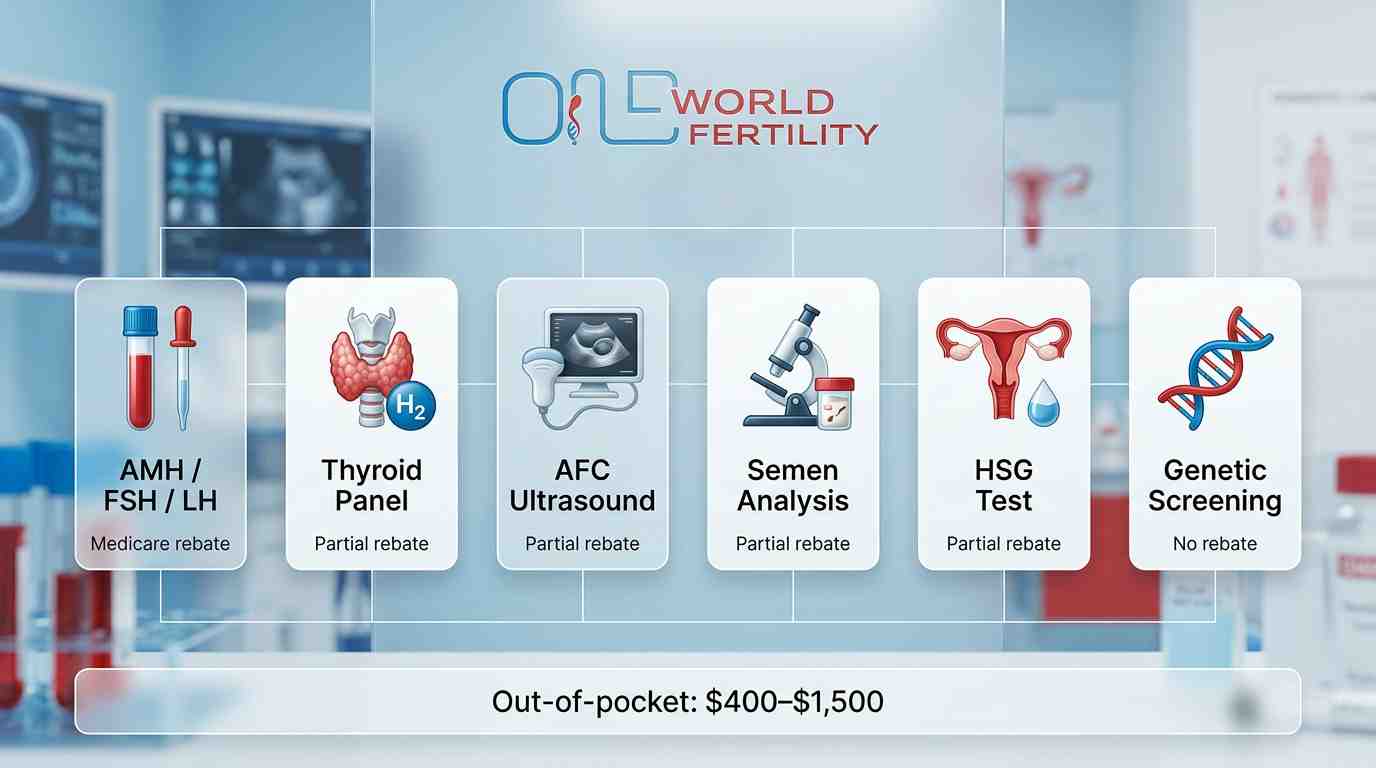
- AMH, FSH, and LH Blood Panels: Check your hormone levels and ovarian reserve; most of these tests qualify for a Medicare refund.
- Thyroid Panel: rules out thyroid-related issues that might affect pregnancy; Medicare partially reimburses
- Antral Follicle Count (AFC) Ultrasound: Checks how your ovaries react to stimulation; partially covered by Medicare
- Semen Analysis: Checks for sperm count, motility, and morphology; Medicare partly pays for it.
- Hysterosalpingography (HSG): checks the uterus and fallopian tubes for obstructions; Medicare covers some of this.
- Genetic Carrier Screening: Finds genetic conditions before treatment starts; not covered by Medicare, and worth setting aside money for separately.
Most of these tests are covered by Medicare, but based on what your doctor suggests, you may still have to pay between $400 and $1,500 out of pocket during the whole pre-IVF testing phase.
Cost of Fertility Tests and Initial Consultation (Australia)
| Fertility Test / Service |
Estimated Total Cost (AUD) |
Est. Out-of-Pocket |
Medicare Rebate? |
| Initial GP Consultation |
$80 – $250 |
$0 – $50 |
Yes |
| Fertility Specialist Consultation |
$250 – $500 |
$100 – $250 |
Yes (partial) |
| AMH Blood Test |
$50 – $100 |
$50 – $100 |
No |
| FSH / LH / Oestradiol Panel |
$30 – $80 |
$0 – $30 |
Yes |
| Antral Follicle Count (AFC) Ultrasound |
$150 – $300 |
$50 – $150 |
Yes (partial) |
| Semen Analysis |
$80 – $150 |
$30 – $80 |
Yes (partial) |
| Hysterosalpingography (HSG) |
$300 – $600 |
$100 – $300 |
Yes (partial) |
| Genetic Carrier Screening |
$400 – $700 |
$400 – $700 |
No |
The out-of-pocket costs are only estimates after Medicare refunds. When comparing clinics, always make sure you know what is and isn't included. For example, some clinics include the first meeting in the price of their IVF package.
Breaking Down the IVF Process and Cost - Step by Step
No one process makes up an IVF cycle. Instead, there are several carefully planned steps, and each one costs money. You won't be caught off guard during treatment if you know the full IVF process and how much it costs at each step. Here's how much each step really costs and how Medicare can help.
Cost of Ovarian Stimulation Medicines in Australia
The cost of fertility medication is often the least thought-about part of an IVF treatment, and it can change a lot. FSH injections, such as Gonal-F and Puregon, tell the ovaries to make more than one egg. GnRH inhibitors stop ovulation from happening too early, and a trigger shot finishes egg maturation before it is taken out. If you have a valid prescription, some of these medicines are covered by the PBS, which can significantly reduce the cost. Some people aren't. Medications can cost anywhere from $1,000 to $4,000 per cycle, depending on your stimulation protocol and the dosage your doctor recommends. After any PBS subsidy, your out-of-pocket cost is about $500 to $2,000.
Cost of Egg Retrieval Procedure in Australia
Egg retrieval is a day-surgery procedure performed under sedation, which means there are two cost layers to account for: the procedure itself and the anaesthetist's fee. Medicare rebates apply to both, but gap fees remain. This is where private health insurance at the Gold or Silver Plus tier makes the most meaningful difference, as it can cover the most important portion of the hospital and anaesthetist gaps that Medicare does not fully offset. Without PHI, out-of-pocket costs for egg retrieval typically range from $800 to $1,800, with the anaesthetist adding a further $200 to $500.
Cost of Embryo Culture and Lab Charges in Australia
Once eggs are retrieved and fertilised, they are cultured in the laboratory under the care of an embryologist, and this is one of the few IVF costs that attracts no Medicare rebate at all. Embryos can be cultured for three days or extended to the Day 5 blastocyst stage for better selection. Lab charges cover embryologist fees, culture media, incubator time, and embryo grading. At the transfer stage, many clinics offer EmbryoGlue -a hyaluronan-enriched transfer medium designed to improve implantation rates. The embryo glue cost typically adds $200 to $400 to the cycle, and while it is optional, it is worth discussing with your specialist.
Cost of Embryo Transfer Procedure in Australia
The process of embryo transfer is pretty simple, but it still costs money. Ultrasound guides the transfer, and mild sedation or local anaesthesia may be used, based on your clinic and its rules. A fresh embryo transfer is usually part of the overall cost of an IVF treatment, and Medicare will pay some of the cost. It is done at the same time as egg retrieval. On the other hand, a frozen embryo transfer (FET) is a different cycle that usually costs between $4,000 and $4,445 all together, which is less than the cost of a fresh cycle.
| Embryo Transfer Type |
Estimated Total Cost (AUD) |
Est. Out-of-Pocket |
| Fresh Embryo Transfer |
$1,000 – $1,800 |
$400 – $900 |
| Frozen Embryo Transfer (FET) |
$4,000 – $4,445 |
$2,474 – $2,799 |
Cost of Different IVF Treatment Types in Australia
The cost and path of IVF are not always the same. The type of treatment your doctor suggests will depend on your specific fertility situation, and each method has its own cost structure. It doesn't matter if you want to use your own eggs and sperm, look into donor options, or go for a less invasive method like IUI. The best way to plan ahead without second-guessing every step is to know how much each type of treatment costs in Australia and how much you will pay out of pocket.
Self-Cycle IVF Cost in Australia - What You Actually Pay
Self-cycle IVF is the first choice for couples because it uses their own eggs and their partner's sperm. A standard self-cycle IVF in Australia costs between $10,500 and $12,388. After Medicare rebates, the first cycle costs about $6,711, the same amount people pay out of pocket. These numbers are based on information from big Australian fertility clinics. Monitoring appointments, egg retrieval, fertilisation, and embryo transfer are usually part of clinic packages. However, medications, anaesthetist fees, and lab add-ons are often paid separately. Before you start, always ask for a full, itemised price. This way, you'll know for sure how much in vitro costs in your case.
Donor Egg IVF Cost in Australia - Full Price Breakdown
It costs more for egg donor IVF in Australia than for a normal self-cycle, and there are legal and medical reasons for that. Australia's donation model is based on altruism and is controlled by state laws, not business rules. This means that donors are not paid, but their acceptable costs are covered. The cost of IVF with an egg donor in Australia runs from about $11,200 to more than $15,000. It depends on the clinic and whether the donor is already known or is found through the clinic's program. This is what makes the price go up:
- Donor recruitment and matching fees
- The giver will go through medical and mental health tests.
- Giving money to cover the donor's reasonable out-of-pocket costs
- Both sides must have their own independent legal documents.
- fees for running classes and setting up clinics
If a woman has very little ovarian reserve, low AMH levels, failed IVF more than once, or whose eggs are getting worse because they are older, she should get donor egg IVF. Even though it costs more, the extra money is well spent because the chance of having a live birth is much higher than with self-cycle IVF.
Donor Sperm IVF Cost in Australia - What to Budget For
When donor sperm is needed, it must come from a licensed sperm bank registered under Australian law. This process costs extra on top of the IVF cycle fee. Donor sperm has to be kept in a secure area for six months, tested for infectious diseases, and genetically screened before it can be used in treatment in Australia. Fees for per-vial vary by bank and source type. Adding donor sperm to a normal IVF cycle usually costs an extra $500 to $1,500. This means that the total out-of-pocket cost for the first cycle is around $6,900 to $7,500. Any experienced fertility counsellor will tell you early on in the process that you should include these fees in your budget from the start and not think about them after the fact.
Embryo Donation IVF Cost in Australia - Most Affordable Donor Option
Embryo donation is when a couple receives embryos that another couple gave after their IVF cycle was over. This is usually the cheapest way to become a donor in Australia. The procedure is basically a frozen embryo transfer cycle because the recipient doesn't have to have their eggs retrieved. The total cost of the procedure ranges from $4,000 to $6,000, based on the clinic. Under Australian law, both the couples giving and receiving must get independent legal advice and sign permission forms before the transfer can happen. These costs need to be added to the overall budget. A scientifically sound and truly accessible way for couples who are okay with it to become parents is through embryo donation.
ICSI and IUI Cost in Australia - Which Treatment Do You Need and What Does It Cost?
Intracytoplasmic Sperm Injection, or ICSI, is a lab procedure that is done as part of a normal IVF cycle. It is suggested when male factor infertility has been found through semen analysis or when previous attempts to fertilize have failed. In Australia, ICSI costs an extra $1,000 to $1,500 on top of the base IVF treatment fee, and Medicare does not cover it. It is most clearly meant for:
- Low number of sperm or sperm that can't move
- Lots of pieces of DNA in sperm
- Previously failed fertilisation in a normal IVF cycle
- Sperm that was taken out surgically (TESA, TESE, PESA)
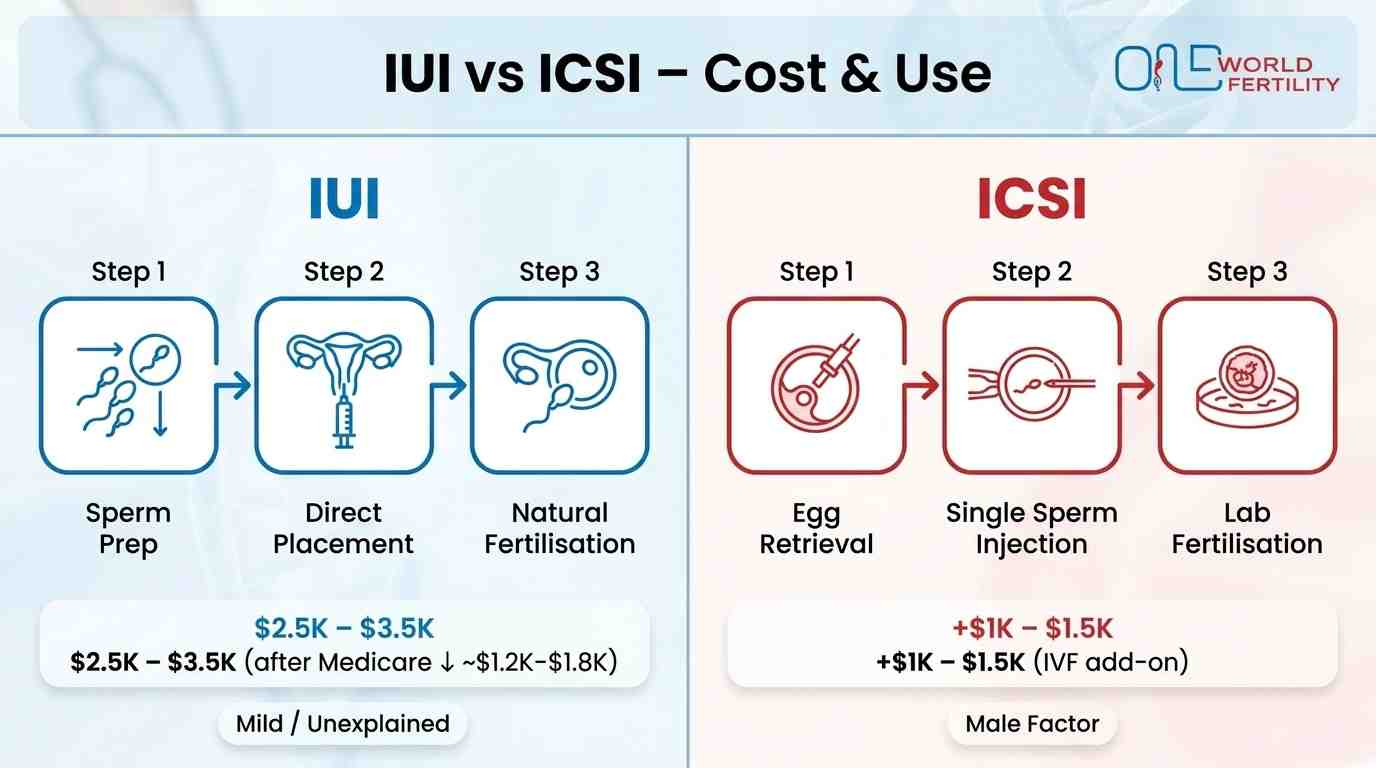
Intrauterine Insemination, or IUI, is a less invasive and less expensive way for couples who are not yet ready for IVF to start their journey. In Australia, IUI costs between $2,500 and $3,500 per cycle. After Medicare refunds, the customer pays about $1,200 to $1,800 out of pocket. It works for couples who can't explain their infertility, have mild male factor problems, or use donor sperm.
| Treatment |
Cost (AUD) |
Out-of-Pocket |
Medicare Rebate |
| ICSI |
$1,000 – $1,500 (added to IVF) |
$1,000 – $1,500 |
No |
| IUI |
$2,500 – $3,500 per cycle |
$1,200 – $1,800 | Yes |
Feeling unsure about which treatment is right for you? That confusion is completely normal - and it is one of the most common things couples feel when they first hear terms like ICSI or IUI. What matters most right now is not the label on the treatment, but the fact that there is a clear, clinically supported path forward for your situation. Both are well-established procedures with strong safety records in Australia. You are not behind. You are exactly where you need to be - and the right specialist will make sure every step from here makes sense for you.
Cost of IVF Add-On Treatments and Lab Procedures
Add-on procedures can help some patients achieve better outcomes, but they aren't always needed for everyone and raise the cost of IVF overall. Here's what each one entails, who should do it, and how much it costs in Australia.
Blastocyst Culture Cost in Australia - Is Day 5 Worth It?
Embryos usually transferred during standard IVF are on Day 3. Continuing culture to Day 5 (blastocyst culture) helps embryologists identify the healthiest embryos before transfer, which can increase the chances of implantation. The cost is about $300 to $600 more than a normal culture, and Medicare does not cover it. When a patient has more than one embryo to choose from, choosing at the blastocyst stage makes it easier to see which embryo has the best chance of becoming pregnant.
PGT-A and Assisted Hatching Cost in Australia
Before transferring eggs, PGT-A checks them for chromosomal problems. This lowers the risk of implantation failure and miscarriage. In Australia, the PGT-A cost includes a biopsy fee of $500 to $800 per embryo and a fee of $2,000 to $3,000 for a batch lab study. Medicare doesn't pay for either one. It is most often suggested for women over 35 who have had multiple miscarriages or failed IVF attempts.
Lasers are used in assisted hatching to help an egg break free from its shell before implantation. The cost of assisted hatching in Australia ranges from $300 to $500, and Medicare does not cover it. It is usually suggested for older embryos, frozen embryos, or embryos that have failed to implant more than once.
Are these add-ons truly necessary for you? A good specialist will always give you a clear clinical reason before recommending either. Neither is a standard requirement for every patient - what matters is whether it is the right fit for your specific situation.
Cost of Egg Donation, Sperm Donation, and Donor Programs
Donor cycles are made up of a lot more than just the clinical process. It takes money to find donors, screen them, ensure they attend counselling, and complete legal paperwork. Most couples in Australia don't plan for these costs when they first start budgeting for a donor cycle.
Egg donation in Australia is purely altruistic. Donors are not paid for their eggs, but recipients are expected to pay the donor's reasonable out-of-pocket costs, such as travel, medical appointments, and any lost income during the donation process. The recipients also pay for the full medical and psychological screening of the donor, as well as fees for clinic planning and program management. These costs are in addition to the base IVF cycle cost and range from $3,000 to $6,000.
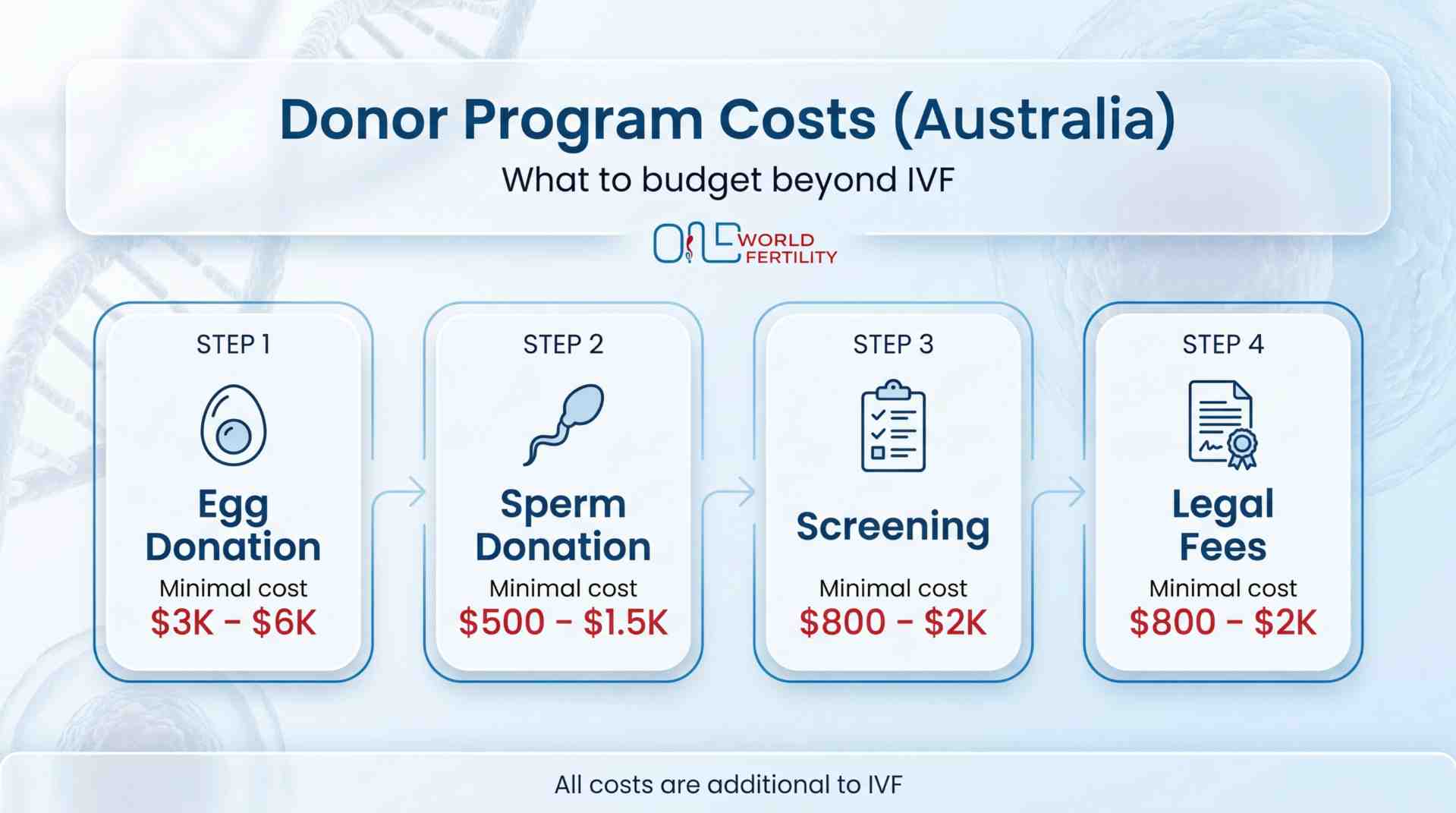
To get donor sperm, you have to go through a licensed sperm bank that follows strict Australian rules. Any vial to be used in treatment must be kept in a quarantine area for 6 months and undergo full infectious disease testing and genetic screening. Most of the time, per-vial fees range from $500 to $1,500 and are not included in the base IVF treatment fee.
Whether you use an egg or sperm donor in Australia, the person who is going to have the baby has to pay for all of the screening costs. This consists of a medical exam, tests for infectious diseases, genetic carrier screening, and a required psychological exam. Prices range from $800 to $2,000, depending on the clinic.
When budgeting for donor IVF legal paperwork is one of the costs people often forget to include. This is true for every donation cycle. Australian law says that both the donor and the recipient must get their own legal help before the treatment starts. Donor agreements need to be written down in a legal way, and in some states, they may also need to be registered with the donor conception registry. The total cost of the lawyers' fees for both sides is usually between $800 and $2,000.
| Donor Cost Component |
Estimated Cost (AUD) |
Medicare Rebate? |
| Egg Donor Recruitment and Program Fee |
$1,500 – $3,000 |
No |
| Egg Donor Reasonable Expenses |
$500 – $2,000 |
No |
| Donor Medical and Psychological Screening |
$800 – $2,000 |
No |
| Sperm Donor Per-Vial Fee |
$500 – $1,500 |
No |
| Sperm Quarantine and Testing |
$300 – $600 |
No |
| Independent Legal Advice (Both Parties) |
$800 – $2,000 |
No |
| Donor Registry Registration (State-Based) |
$100 – $300 |
No |
Cost of Embryo Freezing, Egg Freezing, and Storage in Australia
Some of the most important parts of IVF are the ones that aren't talked about much: freezing. Each of these steps has a cost, whether you are freezing embryos from a previous cycle, storing eggs until you are ready to start a family, or planning a frozen embryo transfer in the future. There is no Medicare refund for any of them. But the chance they keep open is often worth every penny.
Embryo Freezing Cost in Australia
One of the smartest things you can do is freeze the extra embryos if your IVF procedure makes more than are transferred. The original vitrification freeze, the rapid-freeze method used by Australian clinics, costs between $600 and $900. Each year of storage is charged separately at $600 to $900. Medicare doesn't pay for storage, but the fact that those frozen eggs give people another chance without having to go through another full stimulation cycle makes it well worth it.
Egg Freezing Cost in Australia
The process of stimulating and retrieving eggs is the same in egg freezing as it is in IVF. The only change is that the eggs are frozen rather than fertilised. Prices range from $8,000 to $10,000 for the whole process, plus $500 to $800 per year for keeping. It is best for women under 35 who want to keep their fertility up until they are ready to start a family, since that is when their eggs are at their best.
Annual Embryo and Egg Storage Charges in Australia
Storage fees are an ongoing cost that often gets underestimated. Annual charges typically range from $600 to $900 for embryos and $500 to $800 for eggs. One thing worth knowing - clinics will periodically ask you to review your storage arrangements. What to do with frozen embryos is a deeply personal decision, and it helps to know that conversation is coming so it does not feel like a surprise when it arrives.
Frozen Embryo Transfer (FET) Cycle Cost in Australia
It is much cheaper to do a FET cycle than a full fresh cycle, and for many couples, it is the next step that makes the most sense when frozen eggs are available. The total cost is usually between $4,000 and $4,445, and the amount you pay out of pocket is between $2,474 and $2,799 after Medicare refunds. Depending on your medical background, your doctor will either suggest a drug-based or a natural treatment plan.
Do you want to freeze your remaining embryos? Most couples who do say it was one of the best things they have ever done. It doesn't cost much to store embryos, and that frozen one could be the one that changes everything.
IVF Success Rates in Australia - What to Expect
Success rates matter beyond the emotional side -they directly shape how many cycles you may need, and therefore how much your journey is likely to cost overall. All figures in this section refer to live birth rates per embryo transfer - the gold standard measure used by Australian fertility clinics, and a far more honest figure than a positive pregnancy test alone.
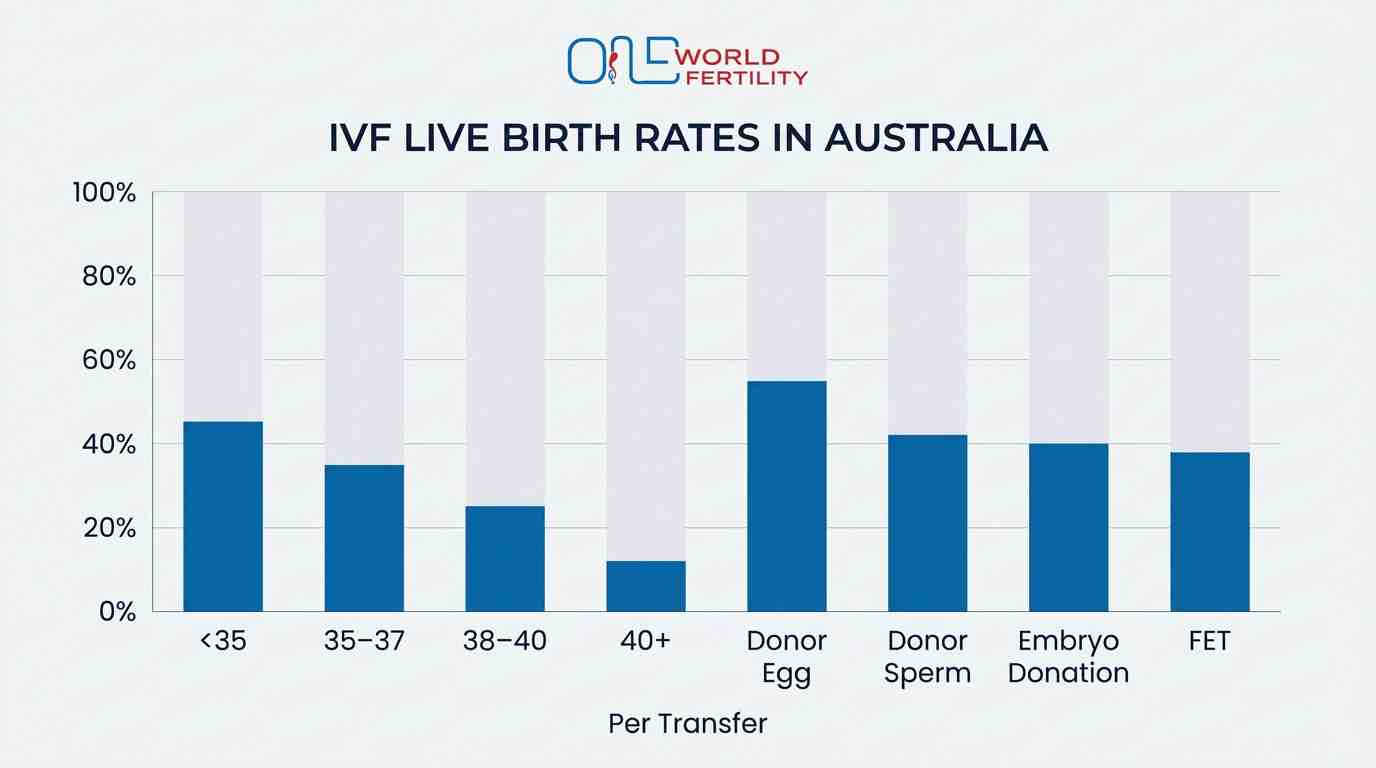
Overall IVF Live Birth Rate in Australia
The national average live birth rate per embryo transfer in Australia sits at approximately 30% to 35% across all age groups. It is worth understanding the difference between a live birth rate and a clinical pregnancy rate - a positive test does not always result in a baby, and clinics that report pregnancy rates rather than live birth rates can paint a more optimistic picture than the reality. Always ask your clinic which figure they are quoting.
IVF Live Birth Rate Under Age 35
The best live birth rates in Australia are among women under 35, at about 40% to 50% per fresh embryo transfer using their own eggs. People in this age range usually have the best eggs and most ovarian reserve. They also have the bodies that respond best to stimulation methods.
IVF Live Birth Rate Age 35-40
After age 35, the live birth rate starts to drop significantly, and now it's somewhere between 20% and 40%, based on the age and other factors. The quality of eggs changes more often, and chromosomal problems in babies happen more often. If you are in this group of women, you should talk to your doctor about blastocyst culture and PGT-A. Both can help you find the best embryos and lower the risk of failed transfers or miscarriages.
Success Rates with Different IVF Treatment Types
Type of treatment has a big effect on how many babies are born alive. Self-cycle IVF results depend on the age and quality of the woman's eggs the most. Because younger donor eggs are used, donor egg IVF always has better success rates, no matter what age the recipient is. The success of donor sperm IVF depends mostly on how fertile the female partner is. When both an egg and a sperm are given, this is called embryo donation. The results are average but reliable. The effects of frozen embryo transfers are about the same as those of fresh transfers, and sometimes they are even a little better because the uterus has had time to heal after being stimulated.
IVF Live Birth Rates by Age and Treatment Type (Australia)
| Patient Profile |
Live Birth Rate Per Transfer |
| Under 35 — Self-Cycle IVF |
40% – 50% |
| Age 35–37 — Self-Cycle IVF |
30% – 40% |
| Age 38–40 — Self-Cycle IVF |
20% – 30% |
| Above 40 — Self-Cycle IVF |
10% – 15% |
| Donor Egg IVF (any age) |
45% – 65% |
| Donor Sperm IVF |
35% – 50% |
| Embryo Donation |
30% – 50% |
| Frozen Embryo Transfer (FET) |
30% – 45% |
Hidden Costs of IVF Most Clinics Don't Mention
The clinic fee isn't the only thing that matters. These are the costs that don't show up in the brochure very often but add up over time. Knowing about them ahead of time will help your budget and your peace of mind.
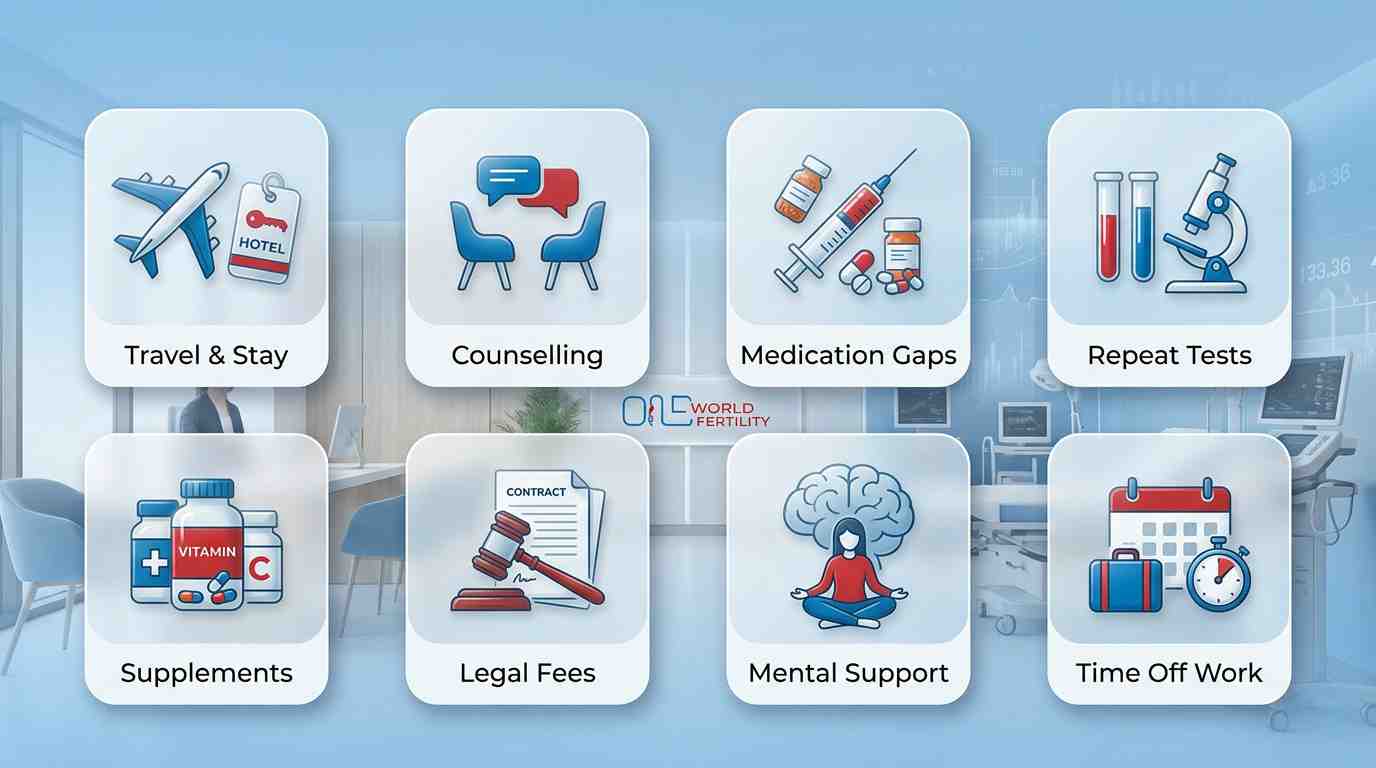
The Costs Nobody Warns You About - But Every IVF Patient Eventually Faces
- Travel and accommodation: Patients from the countryside and rural areas often have to drive to metro clinics for procedures and follow-up care, and those trips add up quickly.
- Mandatory counselling fees: needed for all donor cycles and suggested before treatment starts; sessions usually cost $150 to $300 each.
- Prescription medication gaps: Fertility medicine that aren't covered by the PBS can cost $500 to $2,000 or more per cycle. Always ask your doctor which drugs are covered.
- Repeat testing costs: If a cycle doesn't work, the next one usually needs new blood work, scans, or semen analysis.
- Pre-conception supplements: Medicare doesn't pay for folic acid, CoQ10, DHEA, vitamin D, or omega-3s, and they can cost an extra $50 to $200 a month.
- Legal fees for donor cycles: Both sides must get independent legal help, which isn't usually included in clinic quotes.
- Mental health support: For people who are riding more than one bike, getting ongoing social support is both very helpful and an extra cost.
- Time off work: At least one or two days off are needed for egg retrieval, and monitoring meetings add up over the course of a cycle. This has an invisible but very real financial cost.
IVF Payment Options, EMI, and Finance Plans in Australia
IVF can be expensive, but you don't always have to pay for it all at once. Australian couples can use several legal channels to make treatment more affordable without lowering the quality of care they receive.
EMI and Instalment Plans for IVF in Australia
Many Australian fertility clinics offer payment plans that let you spread the cost of treatment over a few months. Most couples don't realise how common it is to finance IVF. Third-party medical finance companies like TLC Medical Finance and Humm also offer structured payment plans tailored to fertility care. Always review the interest rate, the total amount you have to pay, and any early-return fees before you sign anything. If a plan seems cheap month to month, it may cost a lot more over the course of the whole contract. You should do the math before you sign up.
Can You Access Superannuation to Pay for IVF?
In some cases, you can ask the Australian Taxation Office to let you use your superannuation for charitable reasons to help pay for IVF. There are strict requirements to meet in order to be eligible, and this is really more of a last-resort choice than a simple one. Each application is looked at by the ATO separately, and acceptance is not a given. For the most accurate and up-to-date information on current eligibility requirements and application instructions, the ATO website is the best place to go before going this way.
Final Thought
This guide's numbers all mean something much more important than a price. These two people want to start a family. Someone who has been told the odds are against her. Someone whose thoughts are filled with more hope and fear than the people around them fully understand. The most important thing to remember from this whole article is that you are in charge when you know how much IVF costs, from the first meeting to the final transfer. Not of what will happen, but of the way there. That's more important than most people think. Whether you are just starting to look into this, in the middle of treatment, or picking up where you left off after a failed cycle, you are not going through this by yourself.
One World Fertility offers a free first consultation to help you understand your choices if you are thinking about getting treatment abroad and want to talk to an honest, experienced professional without feeling rushed. There's no duty. Don't rush. They give you just the right information and really care about where your journey takes you. When you're ready, take that first step. When you need help, the right people will be there for you.